Europe is heating up, and so is the battle for a stable climate
Yes, I am enjoying the brighter and warmer weather, although I must admit the heat is a bit harder to deal with since the wonderful NHS fitted a stent to my Left Anterior Descending artery – the so-called “widow maker” – alongside my current medication. I went for a walk today, but had to stop several times to re-hydrate and recover.
Bank Holiday Blossom Fair and Blackbarn Farm
But I am also increasingly concerned about what the rest of this year, and the years ahead, might hold given this heatwave, the wider warming trend, and the super El Niño now developing in the Pacific. It will definitely mean me moving more slowly, and needing more hydration stops.
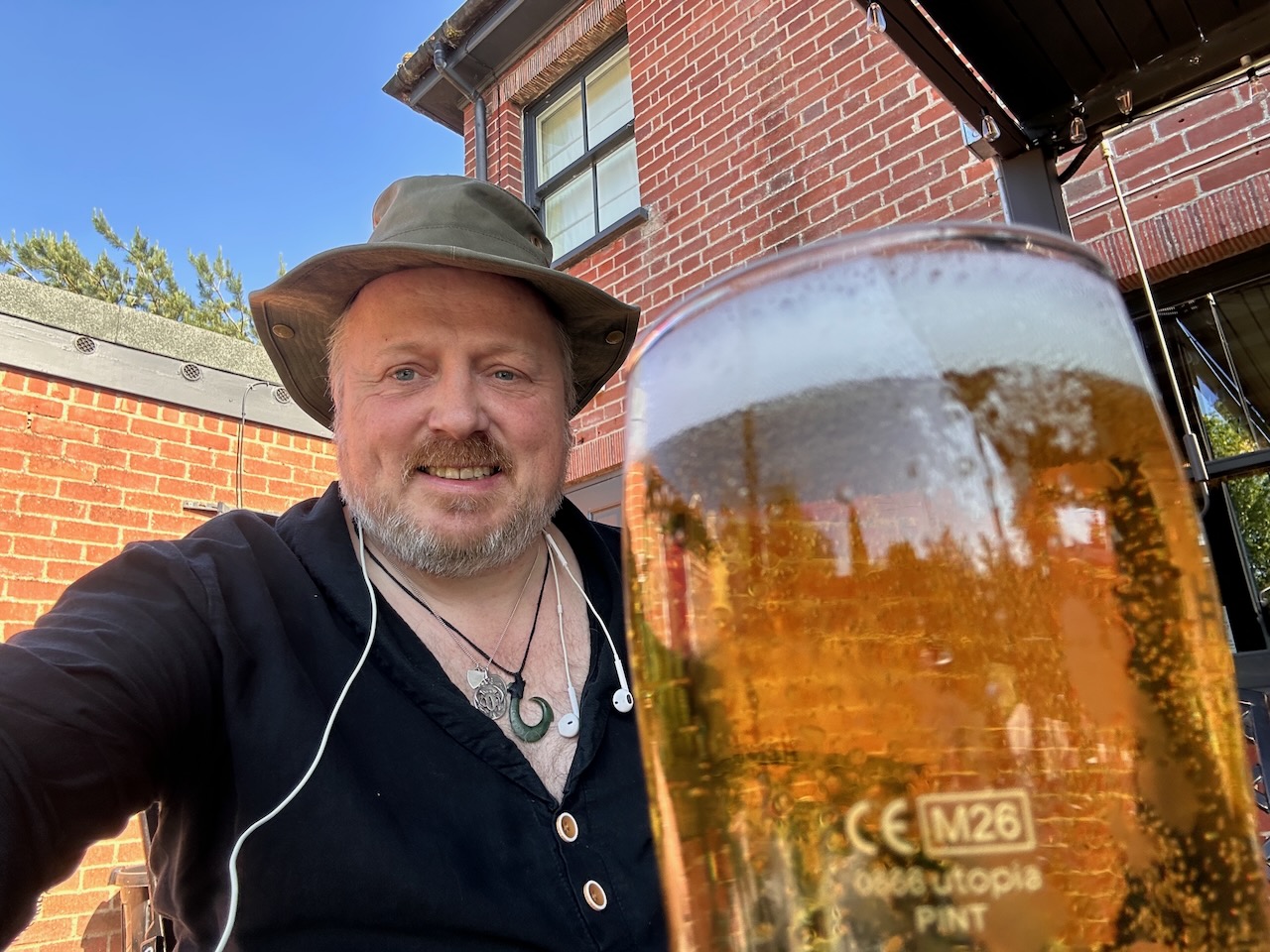
Re-hydrating at The Stag pub, Salhouse
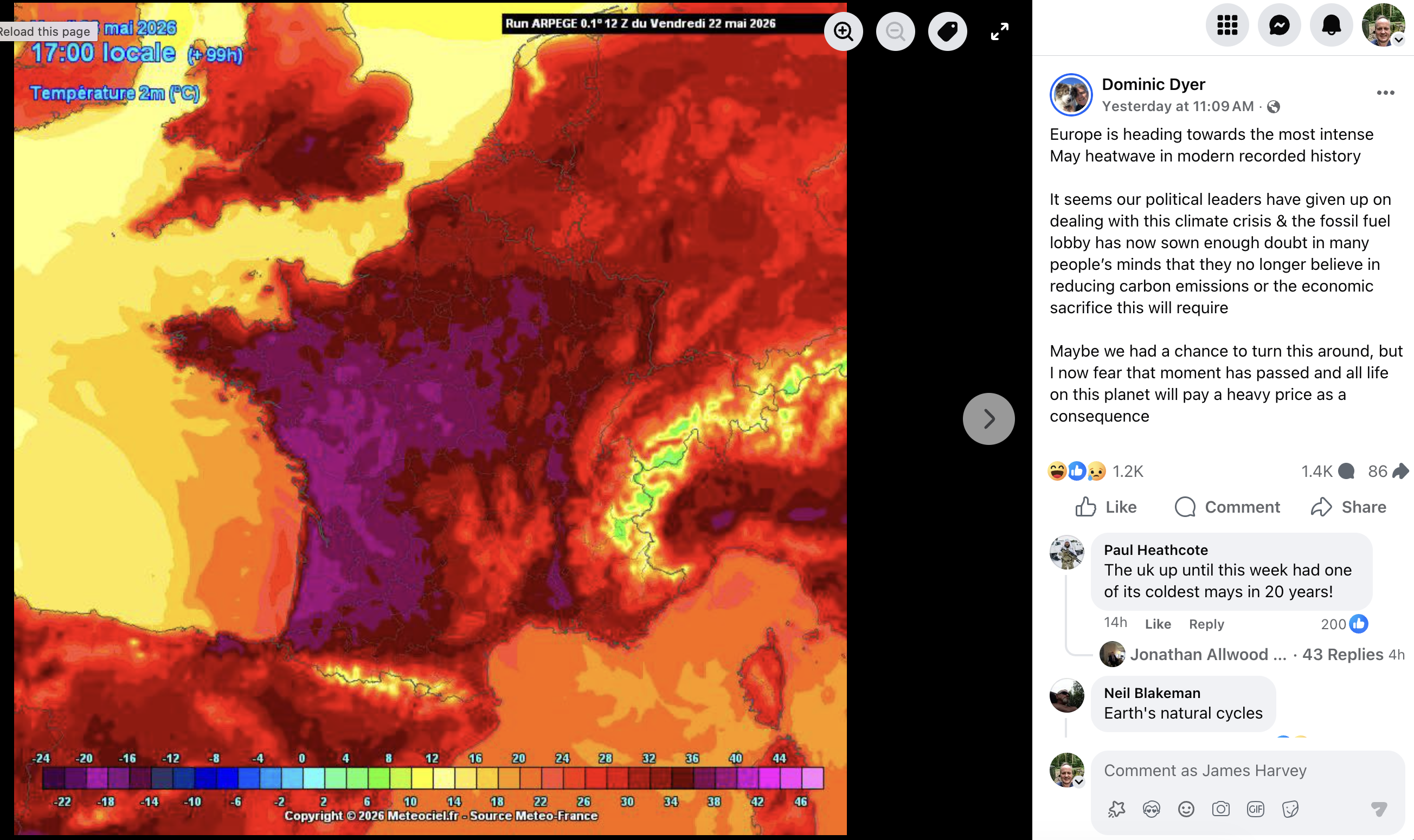
Looking at some of the comments on the post I copied in from Facebook above, I understand why people react the way they do. The UK has just had a relatively cool April and May by recent standards – although that is debatable. Weather fluctuates. People naturally compare what they see outside their window with warnings about global heating.
But I still don’t think most people fully grasp the scale of the unfolding climate and nature crises, or the level of existential threat parts of the world already face right now and that we could within our life-times. Our children will definitely be living in a more unstable, violent and resource strapped world.
Floods. Fires. Crop failures. Water shortages. Rising food insecurity. Conflict over resources. Economic instability. Mass displacement. Refugees risking their lives crossing seas because the places they once called home are becoming unliveable. Yes, that means more small boat crossings. And if AMOC collapse we could be the ones needing the boats, becoming climate refugees ourselves.
And many of those suffering first and hardest are in the global south – countries which contributed far less to historic emissions than wealthy industrialised nations like ours.
We also still massively understate our own contribution. The often-repeated claim that the UK produces “less than 1% of global emissions” ignores the emissions embedded in imported goods, international aviation, shipping, finance and supply chains which support our standard of living, which despite a cost of living crisis and hardship in the home front, is still far above many other parts of the world.
I genuinely think if people fully understood the scale and interconnected nature of these crises, they would support a far faster transition to renewable energy, insulation, public transport and decarbonisation.
Especially because renewable energy is now cheaper than fossil fuels, and because electricity demand is rising not falling. We cannot pretend modern economies will function without large amounts of energy.
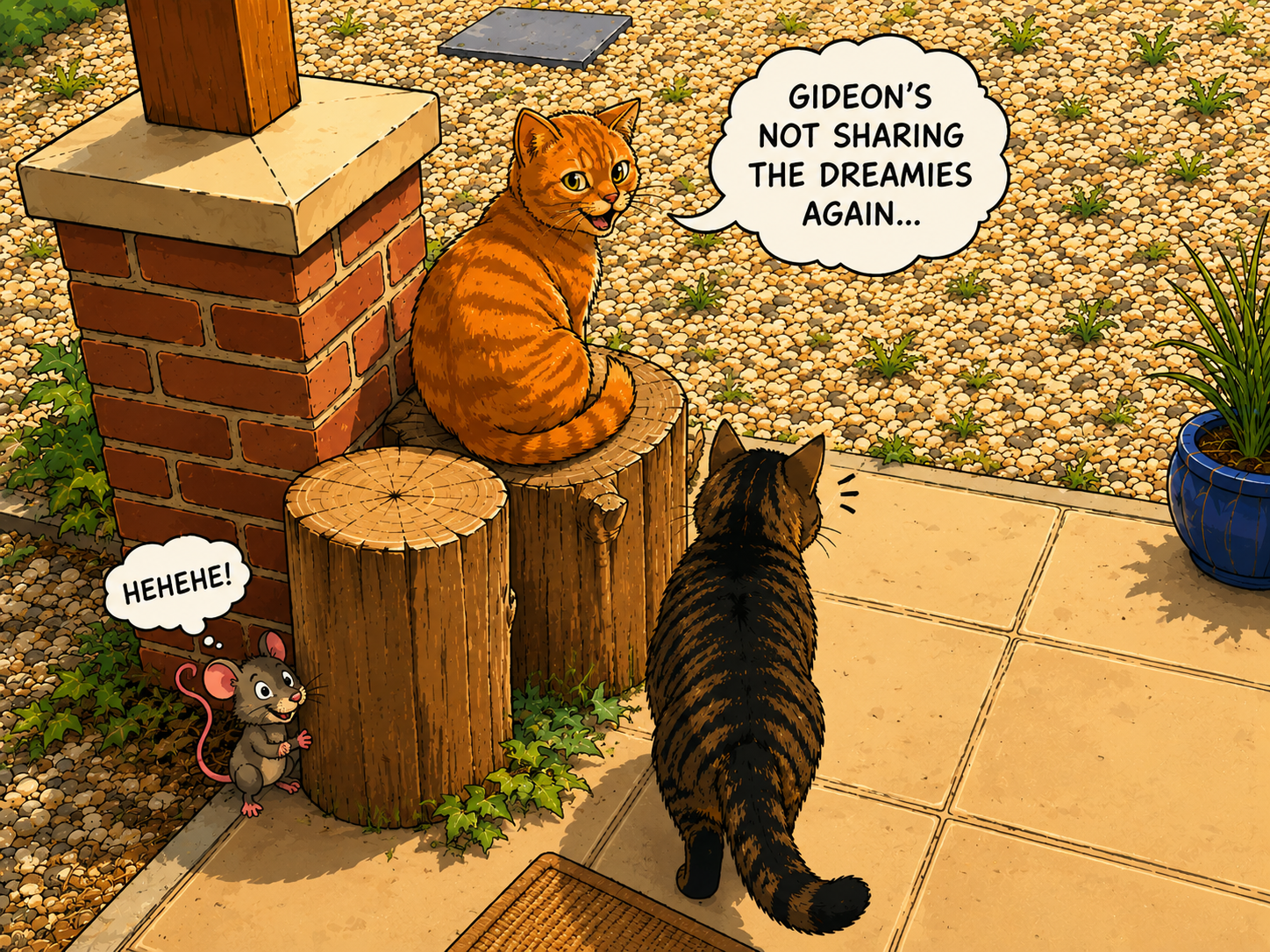
Unless we collectively decide we want a simpler existence in the UK, without a lot of the things we take for granted now, we will need more electricity. Unfortunately civilisation now runs on electricity, Wi-Fi and people asking AI to draw anime versions of their cats – guilty as charged.
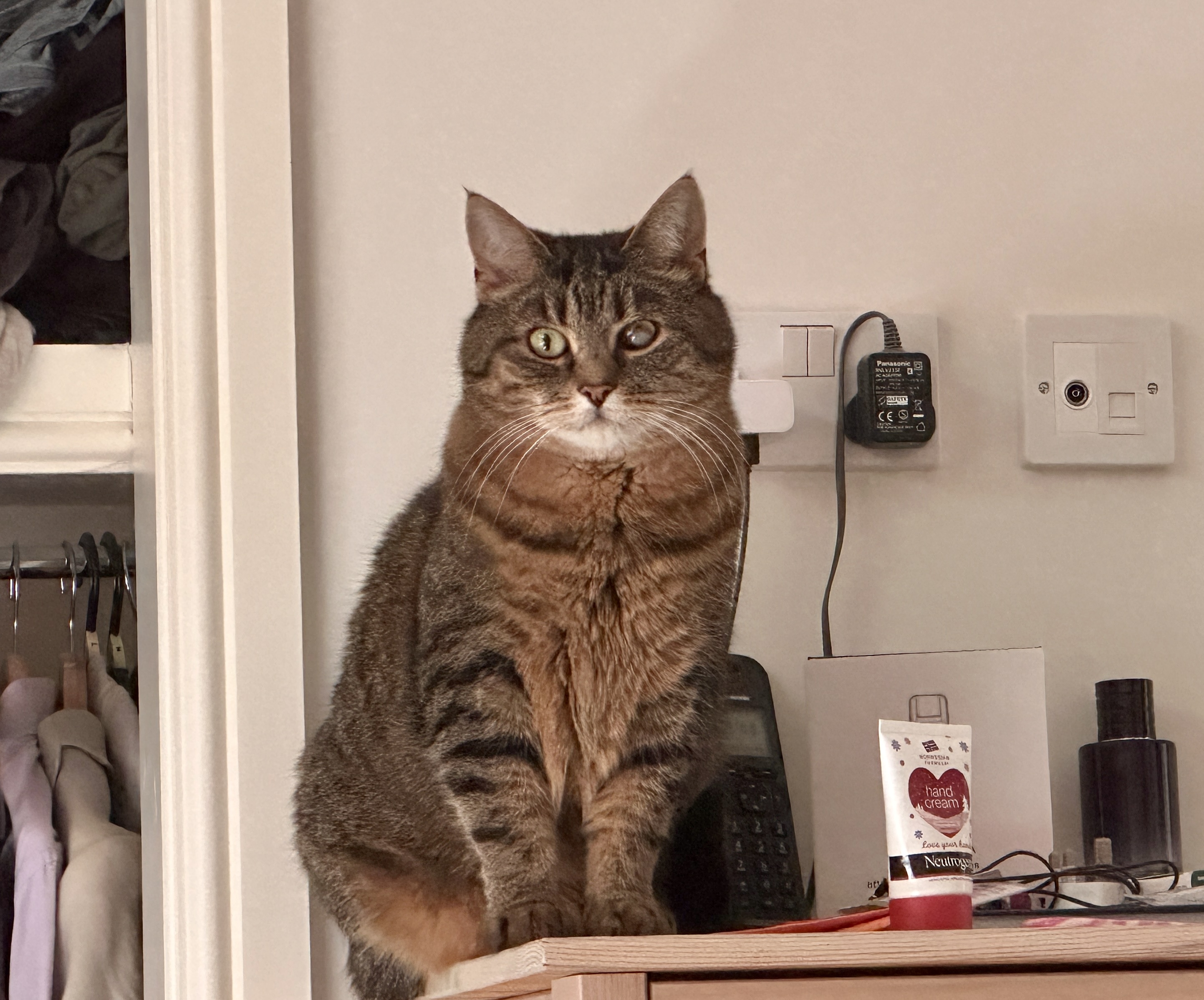
Gideon hanging out in the porch with his mate Ginge
We will have to try to keep up with the rest of the world and build the data centres which in turn can be taxed, replacing income tax, to maintain public services, roads, pensions, NHS, and the welfare state. But maybe it would be better to opt out – some people argue we should simply consume less and live more simply. There is truth in that. A slower, less materialistic society might even be healthier and happier in many ways. But achieving that transition fairly, democratically and globally is an enormous challenge in itself.
The challenge is whether we generate that energy in ways that accelerate collapse, or help stabilise the climate while reducing bills and improving energy security. This comes back to the solar farms argument I’ve previously reviewed – we have to have both roof-top solar and solar farms if we want to survive and thrive.
The first few comments on the original post demonstrate the educational and political challenge we are up against. This is why initiatives like the People’s Emergency Briefing matter so much.
I also increasingly think many politicians are trapped inside a Westminster system built for short-term headlines, election cycles and lobbying pressure rather than long-term planetary stability and our wellbeing.
That frustration is one reason anti-establishment parties are gaining support across Europe and the UK. People feel unheard. They feel politics is performative. And frankly, much of the media ecosystem makes this worse by rewarding outrage, tribalism and simplistic narratives over honesty and systems thinking. We need more authentic and capabable journalism and meda – check out the Media Sovereignty Act:
I do believe many MPs and councillors are decent people trying to do the right thing. But systems shape behaviour. Westminster rewards caution, short-termism and protecting existing power structures. Funny how those power structures always seem to include oil companies, hedge funds and billionaires who own newspapers.
Perhaps that is one reason so many civilisations eventually struggle or collapse: their institutions become unable to adapt quickly enough to the crises they helped create.
I hope the Green Party wins more MPs and councillors. I hope more people engage with politics locally and nationally. But I also suspect deeper democratic reform is needed – including citizens’ assemblies and more participatory forms of decision-making that are harder for vested interests, and frankly the patriarchy, to dominate.
Because ultimately this is not just about carbon emissions.
It is about whether humanity can redesign its political and economic systems quickly enough to remain a stable, compassionate and functioning civilisation in the century ahead.
Meanwhile, Gideon says he needs aid packages because he is worried about food shortages, especially where Dreamies are concerned. Look, he’s on his last legs, well, his legs are in the air anyway, because he’s so weak, allegedly.
Gideon suffering from severe lack of treats, send aid
I am angry. I think I’ve been full of rage for a long time now. But it’s not because I hate people, it’s because I love them – well a lot of them, there are some notable exceptions, let’s not get carried away. It’s the activist mindset of ‘love and rage’, and it keeps me going.
I look around and see a political system visibly failing to respond to the greatest crises humanity has ever faced: climate breakdown, ecological collapse, grotesque inequality, democratic erosion, war, disinformation and the looming disruption of AI and automation.
And yet our politics still feels trapped in short-termism, battling for ratings in a media theatre that ignores truth, whilst our leaders are too cowardly and beholden to the system to do what is desperately needed.
Governments announce climate emergencies whilst approving fossil fuel expansion. Scientists warn of escalating risks whilst billionaires and media barons dominate public discourse. Peaceful protest is criminalised whilst corruption and environmental destruction are treated as normal, even rewarded. Immigrants are blamed for all our problems, rather than inequality and the super-rich exploiting us and the natural world. People are told there is “no money” for welfare, housing or public services – but somehow there is always money for war, subsidies for fossil fuels, or corporate bailouts.
We feel the disconnect. We feel betrayed. Trust in politics is collapsing – it’s already disintegrating. When democratic systems fail to respond to real suffering, people begin searching for alternatives, and as history has shown us they aren’t always good ones. If democracy is perceived as incapable of solving problems, authoritarianism begins to market itself as the solution.
Winston Churchill once said democracy is the least worst form of governance. Socrates was pretty sure democracy was a mistake even though the ancient Greeks invented it. I don’t think the answer is less democracy. It is more democracy – real democracy.
We can’t go on with the current system if we want to survive and thrive. We can’t be reduced to a battle between professionalised parties and politicians every few years, filtered through billionaire-owned media and social media algorithms designed to maximise outrage. We need democratic systems capable of long-term thinking, collective intelligence and genuine public participation.
I increasingly believe citizens’ assemblies must become central to political decision-making. Not just public consultations, but carefully managed exercises that governments are legally bound to act on, and which they can’t ignore. There have been lots of examples of these working, for instance with the abortion debate in Ireland.
We need real citizens’ assemblies:
selected by sortition,
representative of society,
informed by expert evidence,
independently facilitated,
transparent,
protected from lobbying and party control,
and crucially, given real power.
Political theorist Hélène Landemore argues that wider participation often produces better outcomes than narrow elite decision-making. Diversity of experience and perspective matters. Collective intelligence matters. She talks about this in her book, Politics Without Politicians – I find the title somewhat appealing.
Frankly, looking at the state of modern politics, it is difficult to argue elite governance is working well. Westminster has produced a catalogue of failures over the last two decades. The same has and is happening in the USA where one could argue matters are even worse.
Citizens’ assemblies have already shown promise in many countries helping unlock progress on issues traditional politics struggled to resolve. Imagine if they were used seriously in the UK on issues such as:
climate and energy transition,
AI and automation,
housing,
social care,
media reform,
constitutional reform,
immigration,
nature restoration.
Imagine ordinary people being trusted with complexity instead of manipulated with fear – unfettered by corporate interests and not influenced by lobbyists. Most people, when given time, evidence and the chance to deliberate together, are capable of empathy, nuance and compromise. Most people, when told the truth, with options outlined clearly, will choose what will benefit society most. Far more capable, perhaps, than the current political and media class.
Our present system rewards tribalism, outrage, short termism and even narcissism as we’ve seen across the pond. It concentrates wealth and power – there are now 177 billionaires in the UK, up six since 2021. They have a combined wealth of £653bn, roughly 22% of GDP. I found these stats on the net, which I found, frankly, shocking:
The Top 1%: The wealthiest 1% of UK adults control 21.3% of the nation’s total wealth, which equates to a collective value in the trillions.
Bottom 50% Comparison: By contrast, the poorest 50% of the UK population hold only about 4.6% of the country’s total wealth.
The Richest Families: The 50 richest families in the UK hold more wealth combined than the poorest 50% of the population (roughly 34 million people)
I mean, how is this morally justifiable?
The system actively selects against honesty and long-term thinking. This simply won’t work with the number of crises, many of them accelerating, that we’re facing. We need cooperation on a scale humanity has rarely achieved before and if democratic systems cannot evolve to meet that challenge, darker forces absolutely will fill the vacuum. History will repeat itself.
Given recent political events in the UK, I’ve been pondering the best, median and worst case scenarios for the next few years.
Best case scenario — “Green renewal and democratic repair”
The Labour leadership crisis is resolved relatively quickly after a change in direction rather than descending into factional warfare, like we saw with the Tory party. Andy Burnham or a similar figure successfully reframes politics around competence, fairness, infrastructure and hope rather than managerial decline.
Labour forms a broader coalition inside the party with stronger voices on climate, welfare, housing, democratic reform, industrial and economic strategy, immigration and public services.
Investment in renewables, grid upgrades, home insulation, battery storage, public transport and emerging technologies accelerates. Planning reform and grid connection reform finally unblock stalled projects – without compromising nature protections.
Electricity prices fall as the UK becomes less dependent on volatile international gas prices. Energy security improves through domestic renewable generation rather than new fossil fuel dependency.
National infrastructure projects begin to show visible benefits – warmer homes, better rail and bus links, cleaner rivers, new jobs in retrofit and energy, more resilient local economies.
The NHS stabilises through workforce investment, prevention, social care reform and better pay/conditions, reducing burnout and waiting lists.
A more honest public conversation develops around immigration – explaining demographic pressures, NHS staffing needs, agriculture, care work, universities and the economic contribution of migrants. Dehumanising rhetoric loses traction.
Public education, media literacy and local community investment help reduce support for far-right politics and conspiracy movements.
Protest rights are partially restored. Some authoritarian legislation from recent years is rolled back. Peaceful protest and civil liberties are treated as democratic necessities rather than threats and charges are dropped against the 1000’s currently facing prosecution under anti-terrorism laws for holding cardboard placards.
The UK adopts a more balanced and lawful international stance, including stronger pressure for ceasefires, adherence to international law and reduced political tolerance for war crimes or collective punishment. Yes, I’m referring to Israel mostly, but also in Sudan, China, Iran, Venezuela, and other parts of the world.
New North Sea oil and gas expansion remains cancelled as renewables become economically dominant, and the UK becomes energy independent.
Super El-Nino hits with devastating consequences.
Farming policy shifts toward resilience – soil restoration, flood mitigation, regenerative agriculture, food security and partial dietary transition toward lower-emission food systems – plant based diet.
AI and data-centre expansion are regulated and taxed effectively enough that some of the economic gains are recycled into public services, training and eventually forms of income support as automation increases. This could include a Universal Basic Income – we have to tax data centres as income tax revenue falls, due to job losses to AI.
The Green Party of England and Wales continues making gains in local government and Parliament, helping keep climate and nature breakdown politically unavoidable even if not in government.
Media reform begins to address ownership concentration, misinformation, transparency and platform accountability are addressed more seriously – see the Media Sovereignty Act.
Despite worsening climate impacts globally, the UK becomes somewhat more resilient through adaptation planning, flood defence, insulation, energy security and social cohesion.
If Labour could manage that, I’d be both amazed and amazingly grateful.
Median case scenario — “Managed decline with partial progress”
Labour remains in power or remains the largest poltiical force, but internal divisions and fear of media backlash limit ambition – what we have now.
Some green infrastructure succeeds – especially renewables and grid investment (NSIPs) – but projects are slowed by planning disputes, local opposition (NIMBYs), underinvestment and institutional inertia.
Electricity becomes somewhat cleaner, but bills remain high because housing inefficiency, the link to gas prices and infrastructure costs are not fully addressed.
NHS pressures ease slightly in some areas but remain severe overall due to ageing demographics, staff shortages and chronic underfunding.
Climate policy survives but is inconsistent – progress on renewable power exists alongside airport expansion (on the agenda again), road building and continued support for some fossil fuel extraction. Global emissions continue rising.
AI expansion and automation increase inequality faster than political systems adapt to it. Productivity gains mostly flow upward into large corporations and asset owners.
Immigration remains a toxic political issue. Neither side fully wins the argument. Public frustration continues to be channelled toward migrants rather than structural economic problems.
Reform UK and other populist-right forces continue growing but do not fully take power. Their rhetoric shifts mainstream politics further right on migration, protest and culture-war issues.
Protest rights remain restricted compared to previous decades, though not completely dismantled.
Media sensationalism, billionaire influence and algorithm-driven outrage continue dominating public discourse. Trust in institutions remains low.
Climate impacts worsen globally: crop failures, migration pressures, insurance instability and extreme weather increasingly affect everyday life and public finances. Super El-Nino hits with devastating consequences.
The public becomes more politically cynical and emotionally exhausted rather than mobilised – stagnation.
Living standards stagnate for many people, but outright collapse is avoided through continued state borrowing, technological adaptation and institutional resilience.
The Greens continue gradual growth but remain structurally constrained by the electoral system – proportional representation neeeded.
Side noteon data centres and AI: Politicians are failing to keep up with the pace of AI advancement, and the need for data centres to provide a viable economic model – if we don’t want to reject that model completely. In order to be competitive and fund the standards of living, welfare, healthcare, and even military resources we’re used to, then we have to move very quickly, increasing electricity production massively and quickly – which nuclear can’t do but renewables could – as well as the number of UK data centres. The alternative, which actually might be healthier and happier but fraught with peril, is to regress, become far more subsistence based, with communities really supporting one another but without luxuries, holidays and many of the privileges we’ve become used to – maybe that would be a good thing, given we have had our fair share of the carbon budget.
Worst case scenario — “Authoritarian fossil-fuel populism”
Labour fractures after electoral defeats, leadership crises or economic shocks. Progressive politics becomes divided and demoralised.
Reform UK or a broader right-populist coalition wins power during a period of economic stress, migration panic and institutional distrust – this could happen quite quickly.
Net zero policies are heavily weakened or more likely abandoned. New North Sea oil and gas extraction expands while renewable deployment slows through planning obstruction and political hostility.
Energy prices remain volatile due to continued fossil fuel dependence and international instability. More people die from the cold.
Protest laws become significantly harsher. Direct action, climate protest and some forms of dissent are increasingly criminalised or surveilled. More prisons and detention camps are built.
Public broadcasters and regulators face increasing political pressure. Media ecosystems become even more dominated by outrage, disinformation and billionaire influence.
Migrants, refugees, Muslims, LGBTQ+ people and other minorities become central political scapegoats. Hate crimes and political intimidation increase.
Democratic norms erode, but won’t collapse overnight – attacks on courts, civil society, universities, journalists and human rights frameworks become normalised. This is what happened in the 1930s.
Economic inequality worsens sharply. Public services including the NHS deteriorate further through privatisation and austerity-style policies.
AI-driven job losses accelerate without meaningful redistribution, retraining or welfare reform, fuelling anger and instability.
Climate impacts intensify globally while adaptation remains inadequate – flooding, food inflation, insurance withdrawal, water stress and migration pressures become increasingly destabilising.
International instability increases through resource conflicts, wars and geopolitical fragmentation – it’s happening now.
More extreme far-right movements emerge claiming even right-populist governments are “too weak”, driving a further cycle of radicalisation and authoritarianism.
Civil unrest becomes increasingly common – riots, political violence, strikes and heavy-handed policing become part of normal political life.
Institutional trust collapses further as large parts of the public conclude the political system no longer works for them.
Local resistance movements, trade unions, community groups, environmental organisations and some councils continue resisting and building alternative structures of solidarity and resilience – we will not be silenced, and we will not give in to fascism and hate.
Super El-Nino hits with devastating consequences.
Did you spot the bullet point that happens in all the scenarios. It’s my example, and in the case of Super El-Nino probably inevitable, of the impacts of climate breakdown that will happen whatever we do, like sea level rise and coastal cities eventually being swamped.
These scenarios can sound pretty bleak, but the latter has too high a probability for my liking, on our current trajectory. Personally, I have lost faith in our political system, despite being a district councillor and member of the Green Party. Even in the Green Party I’ve seen the desperation to win votes mean people don’t do what is right, and that appears to be getting worse as we get bigger. I will continue to work to the best of my ability within the system, for the moment, but truly believe we need Citizens’ Assemblies to get us out of the mess we’re in.
I do not want a future built on authoritarianism, scapegoating and fear. I want one built on participation, compassion, truth and shared responsibility.
We need to rebuild democracy itself to give long term resilience, community, wellbeing and equality.
We can’t afford to give up, see you on the streets ✊