Tag Archives: Renewables

Andy Burnham’s speech: Radical? I don’t think so.

Andy Burnham’s speech. I listened to it. I thought it was probably one of the best oratorical performances from a Prime Minister I’ve heard in the last 20 years. He actually made it seem like he cares, I think he probably does. He actually showed empathy which the right keep telling us is weak and should be discarded. He actually came out with some decent ideas although the devil will be in the detail.

Electoral reform; will that mean proportional representation?  Looks like it. Marvellous.

Delinking electricity prices from wholesale gas prices; great that should genuinely reduce electricity bills by benefiting from cheaper renewable energy. 

A National Care System; brilliant, we have an ageing population and don’t seem to want to welcome migrant workers to help with that or many other workforce challenges. 

Rejoining the EU; or some positive moves in that direction, maybe a referendum, super, about time, Brexit has and will continue to be a disaster. 

Reform the State Pension; probably needed at this stage, but going to be a hot potato. 

Housing reform; brill, let’s tackle greedy developers and get more affordable and social housing.

Take water companies into public ownership and create a publicly owned Great British Grid to challenge the private network operators; can we do this very quickly please, especially with the water companies. Privatisation, Thatcher’s legacy, has been another disaster.

A more rapid transition to renewable energy; great, get on with it, and whilst you’re at it stop subsidising oil and gas companies and make them pay for a just transition in terms of energy generation and jobs, and make them pay compensation for the damage they’ve done, deaths caused, and clean up operations.

But…

What about taxing the super rich, a wealth tax, nothing on that meanwhile the poverty divide is growing, we’re getting more multimillionaires and billionaires, and society is sick because of them.

What about the climate and nature crises and the threats these present to our national security, food supplies, flood resilience and wellbeing. And you’re allowing homes to be built on floodplains, madness. We’re facing growing risks to food supplies and prices from El Niño, extreme heat, drought, floods and harvest failures. What are you going to do about that? If people don’t have food to feed themselves and their families then law and order quickly breaks down.

What about oceans accumulating extraordinary amounts of heat, with vast areas experiencing marine heatwaves and some regions releasing stored heat back into the atmosphere? Oceans are acidifying, rivers are polluted, fish stocks are declining, and sea levels rising.

Meanwhile, on land wildfires are raging, the Amazon rainforest is at a tipping point and at risk of  turning into savannah then potentially desert, along with the world’s other major rainforests such as the Congo. The Boreal forests that stretch across land masses in the Northern hemisphere aren’t faring much better. We’re in an insect apocalypse – there go our pollinators. And if we’re talking about the UK we’re one of the most nature-depleted countries in the world.

I created a Global Risk Register for a blog a couple of weeks ago, you can view it here – https://selfpropelled.life/2026/09/17/mad-world/

What about the war crimes Israel are perpetrating in Gaza and the West Bank? Trivial sanctions on goods from the West Bank aren’t going to do much. Many genocide scholars, including several from Israel, and Amnesty are calling it genocide. Israel’s actions meet the criteria for genocide. Here’s a reminder from the UN website:

Convention on the Prevention and Punishment of the Crime of Genocide

Article II

In the present Convention, genocide means any of the following acts committed with intent to destroy, in whole or in part, a national, ethnical, racial or religious group, as such:

  • Killing members of the group;
  • Causing serious bodily or mental harm to members of the group;
  • Deliberately inflicting on the group conditions of life calculated to bring about its physical destruction in whole or in part;
  • Imposing measures intended to prevent births within the group;
  • Forcibly transferring children of the group to another group.

Source: https://www.un.org/en/genocide-prevention/definition

Several of those acts have been extensively documented. The crucial legal question is whether they are being committed with the required intent to destroy Palestinians in Gaza, in whole or in part. In my view, the evidence of that intent is overwhelming.

We just need the International Court of Justice to catch up and the International Criminal Court to arrest the perpetrators. There is no doubt in my mind that history, if there is anyone alive to read it, will show a genocide is taking place. The first live-streamed genocide in human history.

And the UK government is, in my view and the view of many others, complicit because we are selling them arms, giving them intelligence, and haven’t imposed proper sanctions on Israel. Andy Burnham won’t even accuse them of war crimes, no doubt because then legally he would have to do something about it. Meanwhile, over 75k dead, including over 20k children. 

We have lost our humanity to the greed and whims of billionaires and their lackeys – on war, climate, nature, energy, the media, even the judiciary. Burnham’s government is still arresting hundreds of people for holding up cardboard signs opposing genocide. The average age and gender of a ‘terrorist’ in the UK must be female, early 60s. Brilliant. Something to be very proud of Labour and Tory MPs.

What about banning politicians from lying in Parliament? What about holding the media to account and demanding they tell the truth? What about getting the BBC to actually do its job and be journalists, not commentators failing to challenge politicians and business leaders on their falsehoods? What about standing up to the far right and fascism in the 21st century?

What about being honest with the public about the challenges we’re facing, why things are going to have to change – for everyone – and bringing us on that journey. If you explain why there are certain things we can’t do or have anymore, because to do so increases the risk of your children dying, people will probably get it. 

Do what is right, not what you think will get you votes, and if you can’t do that hand over decision making to Citizens’ Assemblies – the subject of my blog last week – https://selfpropelled.life/2026/09/22/what-if-politicians-didnt-make-the-decisions/

Was Andy Burnham’s speech good? Sure, it sounded cool. Was it radical, ending neoliberalism and forming a National Care Service? Nah, I don’t think so. Maybe 30 years ago. But now the things he’s proposing should have already been done, or are just what we should be doing as business as usual, not radical.

As it is we are facing multiple concurrent risks and issues that could lead, are already leading in some instances, or will lead to:

  • Food and water insecurity
  • Health impacts and increased mass mortality events
  • Homes and infrastructure damage and destruction
  • Supply chain disruption
  • Insurance and property risk
  • Price and livelihood shocks
  • Inequality and vulnerability
  • Displacement and increased migration across borders
  • Economic and financial stress

These lead to systemic risks, and potentially societal collapse. 

I’d say the latter is looking more and more likely. Yesterday, Burnham should have declared a state of emergency to tackle these issues, and encouraged other world leaders to do the same.

Who knows, trying to stop societal collapse and provide a future for children might be something everyone, aside from perhaps sociopathic billionaires, can get behind.

Here’s a picture of a recent Norfolk sunset, because red sky at night, shepherd’s delight.
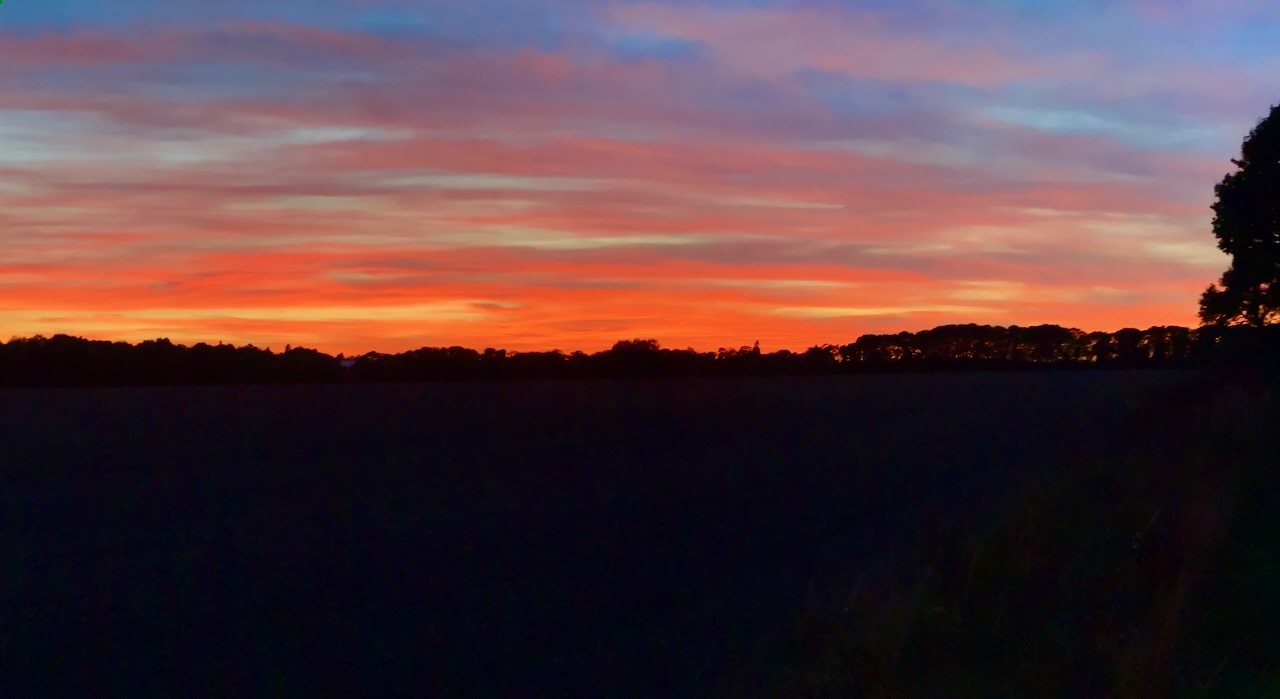
Red sky at night, shepherd's delight.
Red sky at night, shepherd’s delight.
Civilisation Runs on Electricity, Water and Cat Pictures

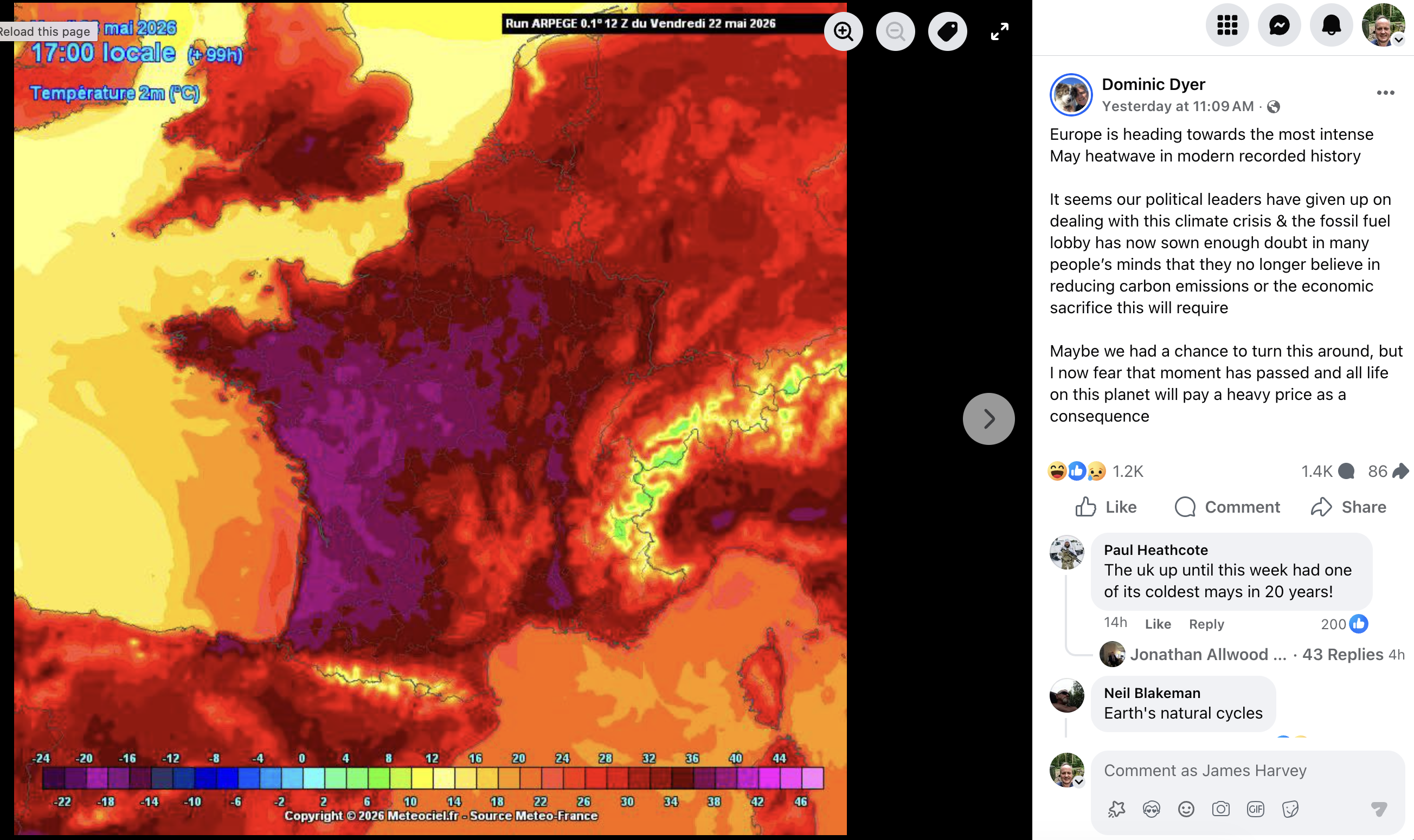
Heat map of Europe, with comments about climate crisis and emissions.
Europe is heating up, and so is the battle for a stable climate

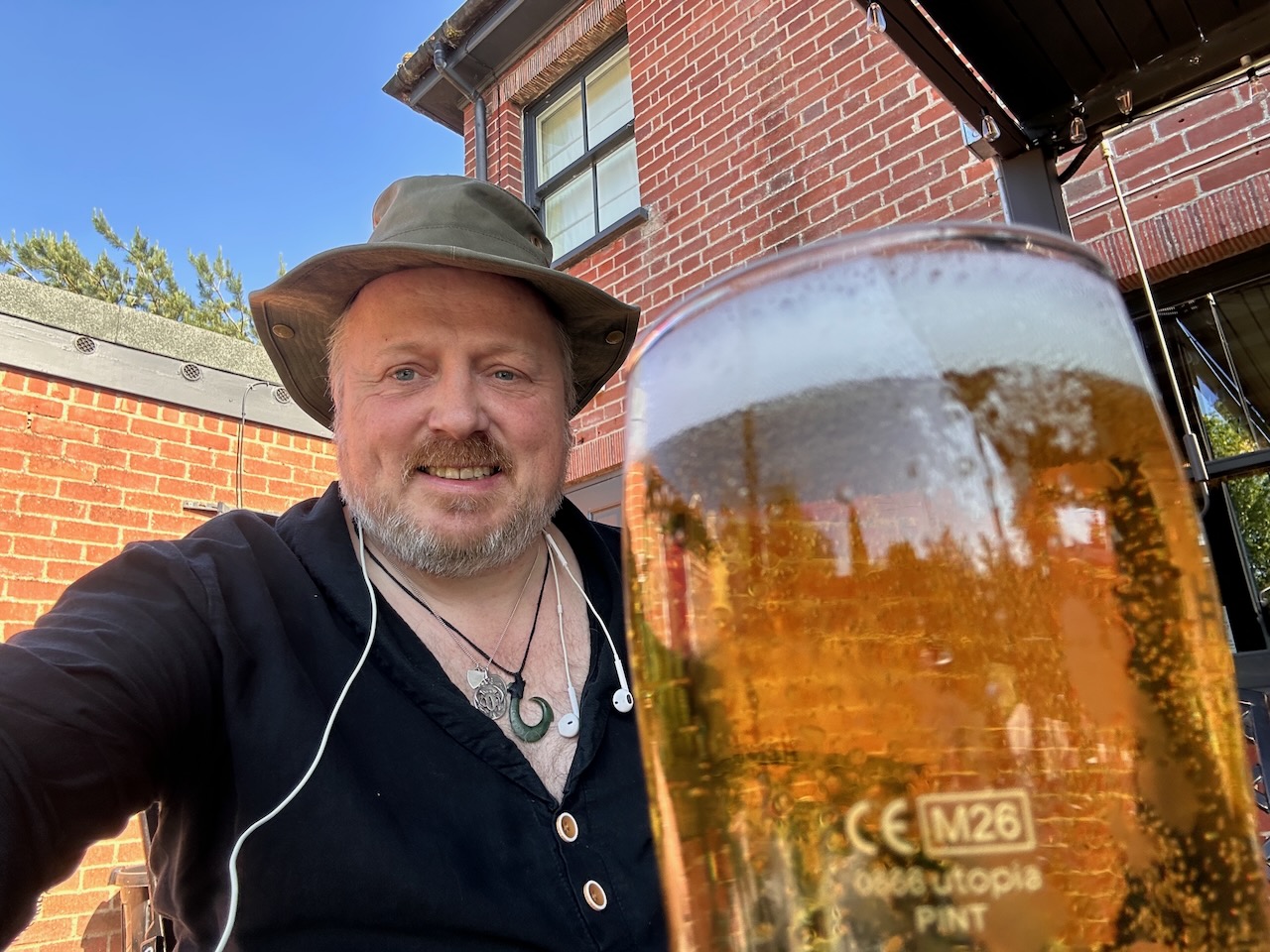
Yes, I am enjoying the brighter and warmer weather, although I must admit the heat is a bit harder to deal with since the wonderful NHS fitted a stent to my Left Anterior Descending artery – the so-called “widow maker” – alongside my current medication. I went for a walk today, but had to stop several times to re-hydrate and recover.

Bank Holiday Blossom Fair and Blackbarn Farm

But I am also increasingly concerned about what the rest of this year, and the years ahead, might hold given this heatwave, the wider warming trend, and the super El Niño now developing in the Pacific. It will definitely mean me moving more slowly, and needing more hydration stops.

Re-hydrating at The Stag pub, Salhouse

Looking at some of the comments on the post I copied in from Facebook above, I understand why people react the way they do. The UK has just had a relatively cool April and May by recent standards – although that is debatable. Weather fluctuates. People naturally compare what they see outside their window with warnings about global heating.

But I still don’t think most people fully grasp the scale of the unfolding climate and nature crises, or the level of existential threat parts of the world already face right now and that we could within our life-times. Our children will definitely be living in a more unstable, violent and resource strapped world.

Floods. Fires. Crop failures. Water shortages. Rising food insecurity. Conflict over resources. Economic instability. Mass displacement. Refugees risking their lives crossing seas because the places they once called home are becoming unliveable. Yes, that means more small boat crossings. And if AMOC collapse we could be the ones needing the boats, becoming climate refugees ourselves.

And many of those suffering first and hardest are in the global south – countries which contributed far less to historic emissions than wealthy industrialised nations like ours.

We also still massively understate our own contribution. The often-repeated claim that the UK produces “less than 1% of global emissions” ignores the emissions embedded in imported goods, international aviation, shipping, finance and supply chains which support our standard of living, which despite a cost of living crisis and hardship in the home front, is still far above many other parts of the world.

I genuinely think if people fully understood the scale and interconnected nature of these crises, they would support a far faster transition to renewable energy, insulation, public transport and decarbonisation.

Especially because renewable energy is now cheaper than fossil fuels, and because electricity demand is rising not falling. We cannot pretend modern economies will function without large amounts of energy.

Unless we collectively decide we want a simpler existence in the UK, without a lot of the things we take for granted now, we will need more electricity. Unfortunately civilisation now runs on electricity, Wi-Fi and people asking AI to draw anime versions of their cats – guilty as charged.

Gideon hanging out in the porch with his mate Ginge. Gideon is not sharing his dreamies.

Gideon hanging out in the porch with his mate Ginge


We will have to try to keep up with the rest of the world and build the data centres which in turn can be taxed, replacing income tax, to maintain public services, roads, pensions, NHS, and the welfare state. But maybe it would be better to opt out – some people argue we should simply consume less and live more simply. There is truth in that. A slower, less materialistic society might even be healthier and happier in many ways. But achieving that transition fairly, democratically and globally is an enormous challenge in itself.

The challenge is whether we generate that energy in ways that accelerate collapse, or help stabilise the climate while reducing bills and improving energy security. This comes back to the solar farms argument I’ve previously reviewed – we have to have both roof-top solar and solar farms if we want to survive and thrive.

The first few comments on the original post demonstrate the educational and political challenge we are up against. This is why initiatives like the People’s Emergency Briefing matter so much.

I also increasingly think many politicians are trapped inside a Westminster system built for short-term headlines, election cycles and lobbying pressure rather than long-term planetary stability and our wellbeing.

That frustration is one reason anti-establishment parties are gaining support across Europe and the UK. People feel unheard. They feel politics is performative. And frankly, much of the media ecosystem makes this worse by rewarding outrage, tribalism and simplistic narratives over honesty and systems thinking. We need more authentic and capabable journalism and meda – check out the Media Sovereignty Act:

I do believe many MPs and councillors are decent people trying to do the right thing. But systems shape behaviour. Westminster rewards caution, short-termism and protecting existing power structures. Funny how those power structures always seem to include oil companies, hedge funds and billionaires who own newspapers.

Perhaps that is one reason so many civilisations eventually struggle or collapse: their institutions become unable to adapt quickly enough to the crises they helped create.

I hope the Green Party wins more MPs and councillors. I hope more people engage with politics locally and nationally. But I also suspect deeper democratic reform is needed – including citizens’ assemblies and more participatory forms of decision-making that are harder for vested interests, and frankly the patriarchy, to dominate.

Because ultimately this is not just about carbon emissions.

It is about whether humanity can redesign its political and economic systems quickly enough to remain a stable, compassionate and functioning civilisation in the century ahead.

Meanwhile, Gideon says he needs aid packages because he is worried about food shortages, especially where Dreamies are concerned. Look, he’s on his last legs, well, his legs are in the air anyway, because he’s so weak, allegedly.

Gideon suffering from severe lack of treats, send aid

Why Aren’t They Listening?

The War between the Land and the Sea

Salt, Sea Devil ambassador: “These are the words of a politician, vetted and craven and hollow. You would answer.”

Barclay, Ambassador for human-kind: “Because we were stupid. That’s the truth of it. And the whole planet is going to hell right now because we didn’t understand the consequences.”

Salt, Sea Devil ambassador: “But now, you do?”

Barclay, Ambassador for human-kind: “Yeah, now we do. Still every day water companies are pumping poison and sewage into our rivers and oceans, all the while dishing out bonuses to their bosses. And the thing is, we are letting them get away with it! We’re just sat at home, flicking through our phones, making tea, thinking it’s someone else’s problem! But it’s not. This is my fault. We all played our part. Now we have to help fix it. And the thing is, our kids know this! Our kids. They’re way ahead of us! Why aren’t we listening? Well, today’s the day we start.”

Salt, Sea Devil ambassador: “I think you are my favourite human.”

_____________________________________________________________________________

This exchange from the new BBC/Disney+ series The War Between the Land and the Sea stayed with me long after the episode finished. The sets, costumes and visuals are impressive — but it was Barclay, the unlikely ambassador thrust into responsibility, who delivers the most piercing truth:

“And the thing is, we are letting them get away with it!”

“Why aren’t we listening?” 

Two lines that feel painfully relevant.

Water companies, oil and gas giants, the media, the banks, and the politicians who prop them up have been getting away with it for decades — and we’ve let them.

Where am I going with this?

This post is about why we must accelerate the transition to renewable energy, whilst also bringing essential services like water back into public ownership. For decades, executives have prioritised profit, bonuses and shareholders over public good. Since privatisation in 1989, it’s been yet another “victory” for neoliberal capitalism — one that has spectacularly screwed us over.

We’ve Been Betrayed

The science on greenhouse gases has been clear for almost two centuries.

  • In 1824, Joseph Fourier described the greenhouse effect.
  • In 1861, John Tyndall identified the gases responsible. The Tyndall Centre for Climate Change Research — named after Tyndall — is just down the road from me in Norwich.
  • In 1900, Knut Angstrom, discovers CO2 strongly absorbs parts of the infrared spectrum. 
  • In 1938, Guy Callendar showed that temperatures rose over the previous century. He demonstrated that CO2 concentrations had increased over the same period, and suggested this caused the warming. His claims were dismissed.
  • In 1968, US President’s Advisory Committee panel warned that the greenhouse effect is a matter of “real concern”.
  • In 1975, scientist Wallace Broecker put the term “global warming” into the public domain.

The above has been followed by countless IPCC (Intergovernmental Panel on Climate Change) assessments, and COPs (Conference of the Parties) to try to solve the challenge of climate breakdown. Some progress has been made, but not nearly enough.

We’ve known the facts. We’ve proven them. And yet oil and gas companies hid their own research, just as tobacco companies once hid the link between smoking and cancer. Billionaire-owned media outlets are defending them. Politicians were and are being lobbied into paralysis – just look at COP30. And so we are being lied to, misdirected and exploited whilst the planet is burning.

We have been failed time and time again by successive Governments who have put the interests of mega-corporations, profit and power, ahead of ordinary people. They have betrayed us to the altar of profit, lied, misdirected, and in some cases filled their pockets with blood money.

We didn’t “fail to understand” — we are being denied the truth.

We’re Not Stupid

Barclay says, “Because we were stupid.”

But we weren’t. We were and are being deliberately misled.

Instead of honesty, we got greenwashing, smokescreens, and faux responsibility — like BP inventing the personal carbon footprint calculator to shift the blame from corporations onto individuals.

Imagine if the public could be given the same clarity scientists shared recently at the National Emergency Briefing. The shift in understanding — and action — might come rapidly and radically.

National Emergency Briefing – https://www.nebriefing.org/

You can find recordings of the various segments of the National Emergency Briefing on YouTube.

How Fast Can We Decarbonise?

In the UK, we’ve reduced emissions — but we still emit far more per person than many countries with less wealth and fewer resources. And we should have made the major cuts twenty years ago. We’re now out of time for a gentle transition. We must act rapidly, even if it’s uncomfortable.

This will upset people, especially in a country used to convenience and abundance. But climate physics does not negotiate. Deaths, harm, migration, are all being caused right now by our carbon emissions.

Our Obligations 

We are privileged — often without realising it. Given our historic emissions, the UK has a moral obligation to move first and fast.

The alternative? Pull up the drawbridge, protect ourselves for a few extra years, and ignore suffering elsewhere. But our food imports, supply chains and future mass migration make that fantasy laughable.

Billions will be on the move. The question is whether we meet that future prepared — or panicked.

Tell the Truth

People are not being told the truth by politicians or the media. If they were, they’d understand what we are facing:

As laid out at the National Emergency Briefing, the collapse of AMOC (the Atlantic Meridional Overturning Circulation – a crucial system of Atlantic Ocean currents acting as a giant conveyor belt) could mean:

  • –30°C winters
  • extreme summer heat
  • chronic water shortages
  • the UK unable to grow food
  • the British becoming climate refugees

The irony isn’t lost on me; one wonders whether we’ll have enough small boats.

Extinction Rebellion warned we needed major emissions cuts in 2018. Oil and gas companies and wealthy governments around the world denied it, buried it, or have since waved around Carbon Capture and Storage — a technology unproven at meaningful scale, and one that conveniently ignores the huge emissions from extraction and transport of natural gas in the first place. Profit over life, again.

So, What Can We Do?

We need rapid, large-scale deployment of renewables:

  • Wind
  • Solar
  • Tidal
  • Geothermal – there’s some exciting stuff going on with old coal mines

Fusion power would be ideal, but remains underfunded and decades away. We also need to upgrade the grid and to build massive battery storage facilities. This is all doable and exciting, and will create huge potential in terms of sustainable economic growth, jobs and wellbeing, we just need the politicians in power to stop dragging their heels.

But there are obstacles. Solar is a prime example.

Solar Energy: What’s The Problem?
Rooftop solar is brilliant — low impact, popular, and efficient. But we no longer have the luxury of time. Large solar farms are faster to deliver and much cheaper per megawatt.

Using ChatGPT for initial comparisons (yes, with a pinch of salt but it saves me hours of trawling through websites and research papers), I asked, when looking at the electricity 4,000 acres solar panels could generate, what is cheaper and quicker to build – a large solar farm or rooftop mounted solar:

Large Solar Farms

  • 400MW: ~£400–600m plus land/grid costs
  • 800MW: ~£800m–1.2bn
  • Build time: 12–24 months after permitting

Distributed Rooftop Solar

  • 400MW: ~£600–800m (likely more)
  • 800MW: ~£1.2bn–1.6bn+
  • Rollout time: 5–10+ years

Planning times for solar farms could be slashed if government finally treated the climate emergency like an emergency.

And then there’s capitalism: energy companies don’t want millions of small producers cutting into profits. Legislation could fix this — but it requires political will. We already know neoliberal capitalism needs serious reform.

As for the criticism that solar farms use agricultural land:

  • They would occupy only 0.45%–0.82% of agricultural land, some of which is fallow at the moment anyway.
  • We already face food insecurity. Solar barely dents agriculture. 
  • Meanwhile, golf courses consume five times more land than solar would — and I know which I’d rather repurpose.

You can’t tee off on a golf course that’s underwater.

Unfortunately, there is significant opposition to solar farms, largely from people living near proposed sites — which is understandable

Grid Upgrades: The Unavoidable Backbone

We need new pylons, underground cables, or subsea routes — plus battery storage. None of this is optional, and the arguments are similar to the above. All options have ecological impacts, but we’re out of time for perfect solutions.

Pylons may be ugly, but they’re cheaper, faster, and even capable of creating wildlife corridors. France has even turned some into public art. If only imagination were a UK policy priority.

Large Scale Renewables Are the Clear Winner

Solar farms and other renewable energy sources are the clear winner if our priority is rapid decarbonisation. They are cheaper, quicker to build, will create new jobs and provide clean energy. They are our future proofing.

We face a choice: continue failing, continue betraying younger generations, retreat into selfishness and isolation—or respond to the climate and ecological emergencies with the urgency they demand, adopting something akin to a wartime mobilisation.

It may already be too late to avoid severe impacts. But every fraction of a degree of avoided warming saves lives, ecosystems and stability.

CO₂ rises → temperature rises → runaway climate impacts:

  • floods, fires, drought, famine, harvest failure, extreme weather, mass migration, ocean collapse, extinction events… and then societal collapse.

The stakes could not be higher.

The Path Ahead

We change — or we face the consequences.

The graph below shows how CO2 concentrations in the atmosphere have changed over the millennia, using data from ice core samples.

Carbon dioxide levels are higher than any time in the last 800,000 years

Renewables give us a fighting chance of reducing emissions and avoiding societal collapse. Oil, gas and nuclear leave only waste and devastation. Renewables can coexist with nature and even help restore it when designed well.

It comes down to communicating honestly, successive governments, oil and gas companies, supported and controlled by billionaire media magnates, have denied people that honesty: change now, or our children will not live to the same age we do. 

We don’t have to let them make us stupid, but they won’t change on their own.
We have to force it.

Let’s Take Back Power

From billionaires. From fossil fuel companies. From media moguls. From corrupted politicians who may not even realise how compromised they are. Let’s stop them getting away with it.

They’ve been getting away with it for decades. They are “craven and hollow.”
We can stop them.

And yes — I’m going to say it:

Vote Green. Let’s make hope normal again

Promoted by James Harvey on behalf of Broadland Green Party, a constituent party of the Green Party of England & Wales PO Box 78066, London, SE16 9GQ