Andy Burnham’s speech. I listened to it. I thought it was probably one of the best oratorical performances from a Prime Minister I’ve heard in the last 20 years. He actually made it seem like he cares, I think he probably does. He actually showed empathy which the right keep telling us is weak and should be discarded. He actually came out with some decent ideas although the devil will be in the detail.
Electoral reform; will that mean proportional representation? Looks like it. Marvellous.
Delinking electricity prices from wholesale gas prices; great that should genuinely reduce electricity bills by benefiting from cheaper renewable energy.
A National Care System; brilliant, we have an ageing population and don’t seem to want to welcome migrant workers to help with that or many other workforce challenges.
Rejoining the EU; or some positive moves in that direction, maybe a referendum, super, about time, Brexit has and will continue to be a disaster.
Reform the State Pension; probably needed at this stage, but going to be a hot potato.
Housing reform; brill, let’s tackle greedy developers and get more affordable and social housing.
Take water companies into public ownership and create a publicly owned Great British Grid to challenge the private network operators; can we do this very quickly please, especially with the water companies. Privatisation, Thatcher’s legacy, has been another disaster.
A more rapid transition to renewable energy; great, get on with it, and whilst you’re at it stop subsidising oil and gas companies and make them pay for a just transition in terms of energy generation and jobs, and make them pay compensation for the damage they’ve done, deaths caused, and clean up operations.
But…
What about taxing the super rich, a wealth tax, nothing on that meanwhile the poverty divide is growing, we’re getting more multimillionaires and billionaires, and society is sick because of them.
What about the climate and nature crises and the threats these present to our national security, food supplies, flood resilience and wellbeing. And you’re allowing homes to be built on floodplains, madness. We’re facing growing risks to food supplies and prices from El Niño, extreme heat, drought, floods and harvest failures. What are you going to do about that? If people don’t have food to feed themselves and their families then law and order quickly breaks down.
What about oceans accumulating extraordinary amounts of heat, with vast areas experiencing marine heatwaves and some regions releasing stored heat back into the atmosphere? Oceans are acidifying, rivers are polluted, fish stocks are declining, and sea levels rising.
Meanwhile, on land wildfires are raging, the Amazon rainforest is at a tipping point and at risk of turning into savannah then potentially desert, along with the world’s other major rainforests such as the Congo. The Boreal forests that stretch across land masses in the Northern hemisphere aren’t faring much better. We’re in an insect apocalypse – there go our pollinators. And if we’re talking about the UK we’re one of the most nature-depleted countries in the world.
What about the war crimes Israel are perpetrating in Gaza and the West Bank? Trivial sanctions on goods from the West Bank aren’t going to do much. Many genocide scholars, including several from Israel, and Amnesty are calling it genocide. Israel’s actions meet the criteria for genocide. Here’s a reminder from the UN website:
Convention on the Prevention and Punishment of the Crime of Genocide
Article II
In the present Convention, genocide means any of the following acts committed with intent to destroy, in whole or in part, a national, ethnical, racial or religious group, as such:
Killing members of the group;
Causing serious bodily or mental harm to members of the group;
Deliberately inflicting on the group conditions of life calculated to bring about its physical destruction in whole or in part;
Imposing measures intended to prevent births within the group;
Forcibly transferring children of the group to another group.
Several of those acts have been extensively documented. The crucial legal question is whether they are being committed with the required intent to destroy Palestinians in Gaza, in whole or in part. In my view, the evidence of that intent is overwhelming.
We just need the International Court of Justice to catch up and the International Criminal Court to arrest the perpetrators. There is no doubt in my mind that history, if there is anyone alive to read it, will show a genocide is taking place. The first live-streamed genocide in human history.
And the UK government is, in my view and the view of many others, complicit because we are selling them arms, giving them intelligence, and haven’t imposed proper sanctions on Israel. Andy Burnham won’t even accuse them of war crimes, no doubt because then legally he would have to do something about it. Meanwhile, over 75k dead, including over 20k children.
We have lost our humanity to the greed and whims of billionaires and their lackeys – on war, climate, nature, energy, the media, even the judiciary. Burnham’s government is still arresting hundreds of people for holding up cardboard signs opposing genocide. The average age and gender of a ‘terrorist’ in the UK must be female, early 60s. Brilliant. Something to be very proud of Labour and Tory MPs.
What about banning politicians from lying in Parliament? What about holding the media to account and demanding they tell the truth? What about getting the BBC to actually do its job and be journalists, not commentators failing to challenge politicians and business leaders on their falsehoods? What about standing up to the far right and fascism in the 21st century?
What about being honest with the public about the challenges we’re facing, why things are going to have to change – for everyone – and bringing us on that journey. If you explain why there are certain things we can’t do or have anymore, because to do so increases the risk of your children dying, people will probably get it.
Was Andy Burnham’s speech good? Sure, it sounded cool. Was it radical, ending neoliberalism and forming a National Care Service? Nah, I don’t think so. Maybe 30 years ago. But now the things he’s proposing should have already been done, or are just what we should be doing as business as usual, not radical.
As it is we are facing multiple concurrent risks and issues that could lead, are already leading in some instances, or will lead to:
Food and water insecurity
Health impacts and increased mass mortality events
Homes and infrastructure damage and destruction
Supply chain disruption
Insurance and property risk
Price and livelihood shocks
Inequality and vulnerability
Displacement and increased migration across borders
Economic and financial stress
These lead to systemic risks, and potentially societal collapse.
I’d say the latter is looking more and more likely. Yesterday, Burnham should have declared a state of emergency to tackle these issues, and encouraged other world leaders to do the same.
Who knows, trying to stop societal collapse and provide a future for children might be something everyone, aside from perhaps sociopathic billionaires, can get behind.
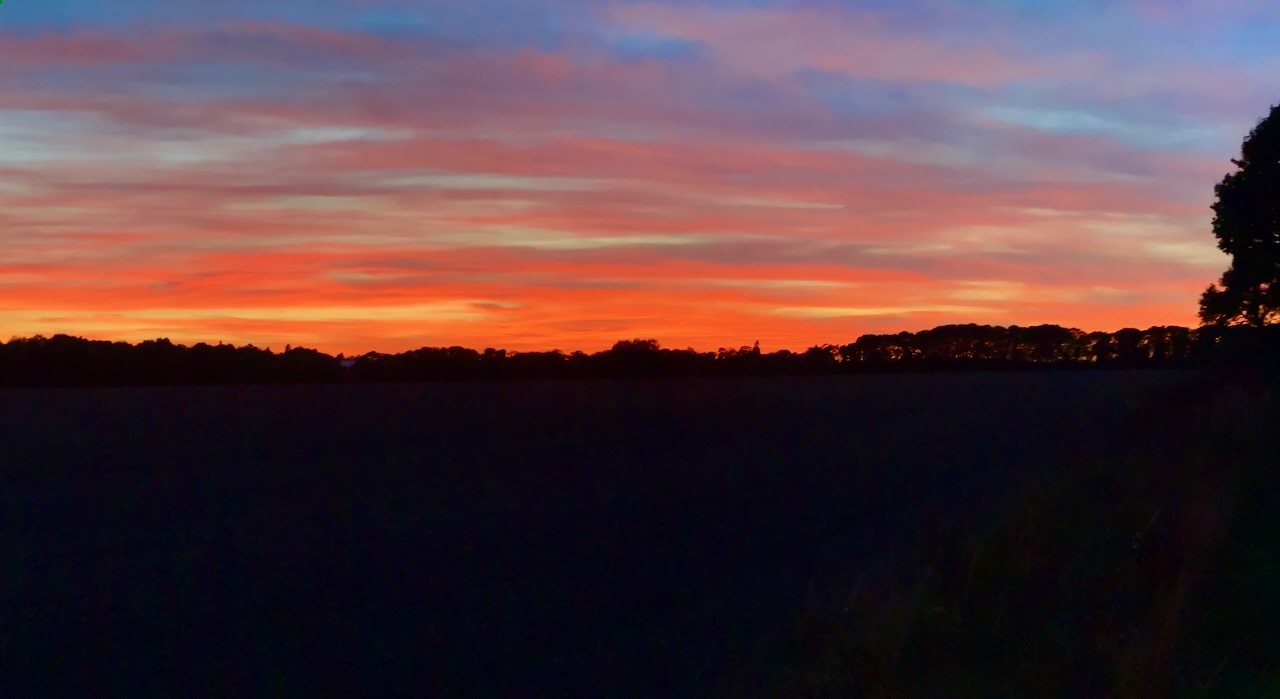
Here’s a picture of a recent Norfolk sunset, because red sky at night, shepherd’s delight.
All around me are familiar faces Worn-out places, worn-out faces Bright and early for their daily races Going nowhere, going nowhere
Their tears are fillin’ up their glasses No expression, no expression Hide my head, I wanna drown my sorrow No tomorrow, no tomorrow
….the Gary Jules version
Over the last couple of weeks I’ve been thinking a lot about risks. Actually, that’s a lie, I’ve been thinking about these sorts of risks for years. It’s quite tiring. Regard that last sentence as British reservedness.
As a project manager, I’m trained to identify what could go wrong, how likely it is, how serious the consequences would be, how risks interact, and what you can do to mitigate, resolve, or in some cases review if we should accept them.
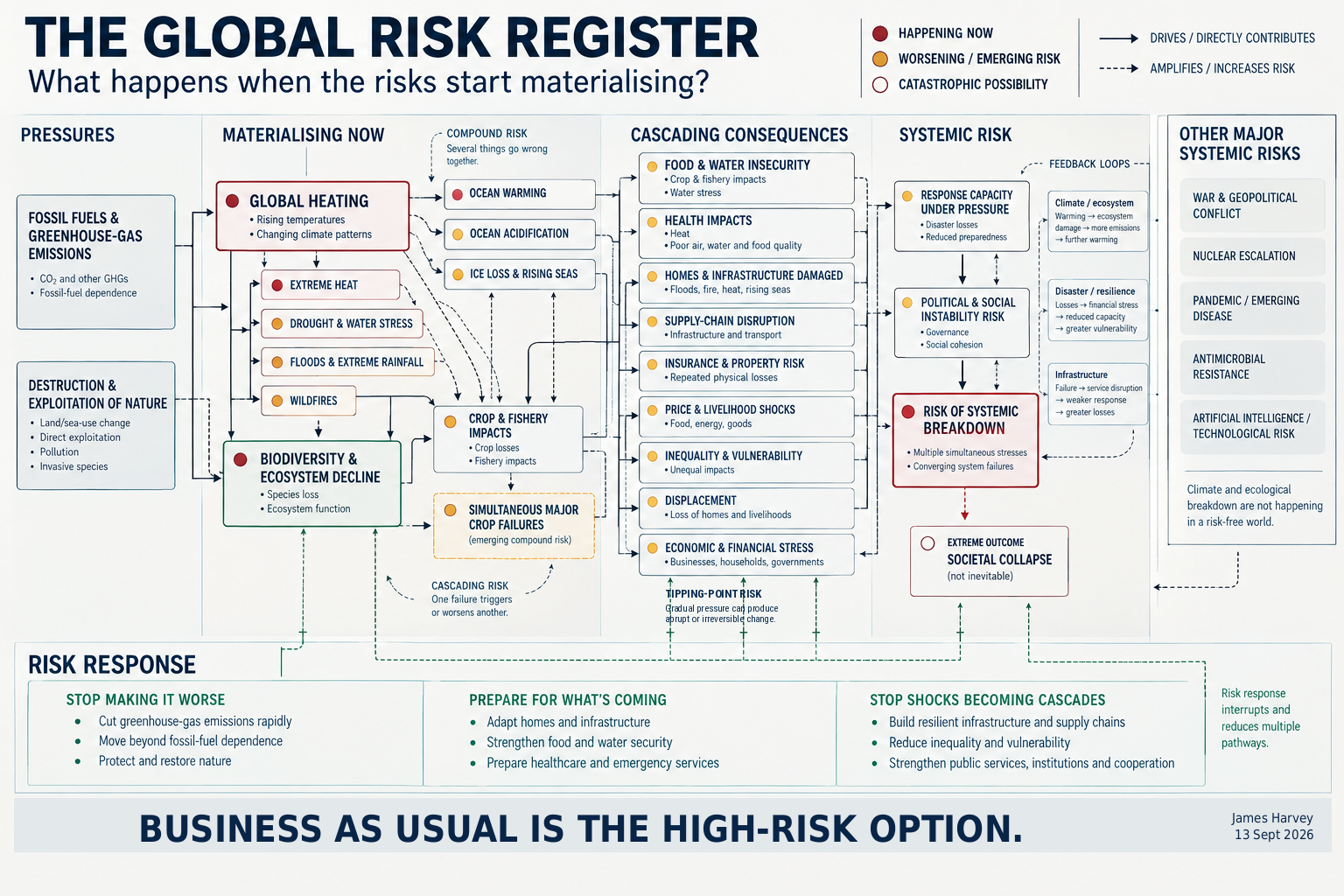
I’ve been wondering what a global risk register would look like, and what the consequences are when you pull them all together.
I’ve stared at this a lot since finishing it. Wondering if I missed anything, or if I’ve exaggerated any of the risks or consequences. If anything it’s probably conservative, as I’ve tried to stick to peer-reviewed science and analysis. One could argue that matters are, in fact, a lot worse. Talk to climate scientists away from the careful language of papers and reports and, in my experience at least, some will tell you just how frightened they really are.
I’ve not put a particular timeline against this, other than some of the boxes are already happening. Personally, I find it increasingly difficult to see how we avoid the systemic breakdown box on our current trajectory. I don’t know when, and I still think we have options. Options are important.
It’s not a very pleasant diagram. Not because every risk shown here will materialise at its worst. They won’t, probably. But some already have. Others are becoming more likely or more severe. And, crucially, they are not independent. Heat affects food. Floods affect infrastructure. Infrastructure affects supply chains. Disasters affect insurance and public finances. Food and housing costs affect poverty and inequality. Those stresses affect societies’ ability to cope with the next crisis.
I added a box on the right hand side too. Other major systemic risks. Because we are facing a multitude of potential catastrophes – I am sure I’ve missed some, feel free to add to the list – we also face war, nuclear escalation, pandemics, antimicrobial resistance and rapidly developing artificial intelligence. I felt like I should add patriarchy, but that’s more a cause than a symptom.
This is the worst risk register I’ve ever looked at. I don’t know how we can start to manage it. If this were any other project, would we really look at it and conclude that business as usual was the safe option? But that’s often the funny thing about risk registers, project managers wave them in front of their sponsors, and they often don’t really look at them, don’t really register or feel what they could mean in terms of successful outcomes. Then, unsurprisingly, projects are often delayed, collapse, or change far beyond their initial remit – I am sure many project managers can empathise.
I should add – I’ve seen many excellently run and delivered projects, at least a couple of them by my good self. They work really well when stakeholders and the project team are engaged and understand what is happening, what the risks and issues are, and what they need to do to help ensure delivery is a success. I maintain that project management, really, is about making lists, effective communication, and nagging.
Back to the diagram. I can create a risk register. Put it in colourful boxes. Draw arrows between the boxes. Find sources for every claim. Make sure every arrow can be defended.
But I can’t put on the diagram what knowing all this makes me feel.
That is, perhaps, the most important bit. People can be good at reading stuff, analysis, reaching conclusions, and they can also be rubbish at it. They can also forget facts and stuff they’ve read quite quickly. I do it all the time as a project manager – I move from one delivery to another, and once one is done I file it in my mind, find myself remembering the high level bits, but the detail is gone after around 3 months because I’ve had to move on something else.
Facts are capricious. Easily forgotten or laid aside in favour of something more current. Like Harry and Meghan. Or Farage. Or Eastenders. We are a wonderfully distractable species and our media and politicians know it.
What aren’t so forgettable, or deletable, are feelings, emotions. A diagram doesn’t necessarily invoke feelings, although this one did for me. A song, a smell, a picture, can all invoke powerful memories that are retained for a lifetime. A diagram doesn’t do that. Strong emotions, felt at a particular event, tied to sensory inputs, have, I think, a far greater chance of being retained.
I think people need to feel these risks. Sadly, many already have as they materialise into regional issues – smoke from fires, hunger in the belly, a parched throat, being engulfed by flood waters, mud, or rockslides, grief at a lake or river dying, a forest or a glacier disappearing, or another animal going extinct.
Feeling is so important. I think only when we really feel what is happening are we motivated to change course. I am talking about when things really matter – health, survival, future generations, survival – food, shelter, warmth.
It makes me frightened. It makes me angry. Often it makes me despair. Because we know what is happening. We know what we need to do. And still we carry on. We let our elected leaders, corporation bosses, billionaires, carry on. ‘Keep calm and carry on’ …screw that.
Can you feel the rage, the grief? Born out of love, but also just, fucking, rage, that we are and have been led to this place. A place where nature is dying – I saw thousands of dead fish floating in the Wensum the other day but it’s alright as Anglian Water shareholders are doing okay – people are dying, especially in the Global South – see Nepal, India, Pakistan, Bangladesh, Tanzania, Zambia, Libya, Zimbabwe, even the USA, although it is better endowed to cope with such events. Is this alright? I guess it is if you just see it on TV or in a newspaper, but what if you actually feel it, and what it could mean for you and people you care about?
I feel it. Every single day. My activist friends – and I hate calling them activist friends, they’re people that just deeply care and can’t stand by – they feel it. Every. Single. Day.
Actually, a lot of religious leaders feel it and have called out that we need to do something, urgently, including the Pope I think. I am sure a lot of charities feel it, as demands on their dwindling resources grow. And some political leaders do, including António Guterres, and a few others. Not many, sadly.
One can present a table of risks, or consequences. One can publish such a thing in countless scientific journals, newspapers, books. But unless people emotionally connect with what is happening, and aren’t anaesthetised by the drugs of social media and TV, we aren’t going to have the revolution – preferably non-violent and accountable – that is needed.
I take action because action gives me hope. XR and Just Stop Oil gave me hope. Defend Our Juries gives me hope. Seeing people sitting in a road with other ordinary people and refusing to cooperate with something profoundly wrong gives me hope. But increasingly I find myself asking whether actions involving tens, hundreds, even thousands of us can possibly force change on the scale now required.
Perhaps we need millions. Not just in the UK. Globally.
It is, after all, a minority of the super rich and powerful, and the vested interests they benefit from and protect, that are disproportionately driving so much of this – climate breakdown, biodiversity collapse, grotesque inequality, hunger, thirst, the sixth mass extinction…I could go on.
Perhaps we need to stop.
Actually stop.
Not a march on a Saturday afternoon. Not another pointless petition. Not another consultation. Not another promise that if we vote differently in four years’ time things might get better.
Workers stop working. Offices empty. Trains stop. Deliveries stop. Shops close. Production stops. The machinery of business as usual stops. Just Stop.
Hospitals keep caring for people. Carers keep caring. Firefighters respond to fires. Essential services necessary to protect life continue.
But everything else?
A general strike, on a scale that cannot be ignored.
Because political and economic power ultimately depends upon millions of ordinary people continuing to cooperate with it. We work. We produce. We buy. We move things. We keep institutions functioning. We make other people rich.
What happens if, together, we withdraw that cooperation? Perhaps it could start in the UK. Perhaps elsewhere. Perhaps everywhere. Because ordinary people across the world mostly want the same basic things: safety, food, shelter, family, friendship, love, a future.
And yes, this will likely mean lifestyle changes. It will mean accepting that we can’t have all the things we wanted, and that our futures are going to be quite different from what we anticipated. But at least we’ll be alive, and our children will have a chance of a future.
We could even be happier and healthier, with better communities and greater connection.
Surely survival is the priority? Not war. Not greed. Not GDP. Not AI. Not the space race.
What happens if we say: not again until you deal with this?
No more HARM.
Options are important. We still have them. We can stop making things worse. We can prepare for what is already coming. We can protect each other. Restore nature. Build stronger communities. Stop cooperating with systems that are causing so much harm.
None of that guarantees everything will be okay. It won’t be. That’s not how risk works.
But business as usual is an option too.
It’s the high-risk option.
Just. Fucking. Stop.
And sorry, project manager mode, here’s the table I pulled together to inform the risk diagram that people will forget, but hopefully they’ll remember the rage, grief, and love.
Risk / issue
Status
Direction
Potential severity
What it can lead to / amplify
Evidence and current assessment
Greenhouse-gas emissions / fossil-fuel dependence
HAPPENING NOW
↑
Very high
Further heating; ocean warming; sea-level rise; extremes; tipping risks
UNEP’s 2025 assessment puts current-policy warming at about 2.8°C this century, with full implementation of current Nationally Determined Contributions at about 2.3–2.5°C. (UNEP – UN Environment Programme)
Global heating
HAPPENING NOW
↑
Very high
Heat; drought; heavy rainfall; fire; ecosystem damage; food/water stress
WMO reports 2015–2025 were the hottest 11 years observed and 2025 was about 1.43°C above 1850–1900. (World Meteorological Organization)
Extreme heat
HAPPENING NOW
↑
Very high
Mortality; illness; labour losses; crop stress; infrastructure/energy pressure
WHO says exposure is growing in every region; mortality among over-65s increased about 85% between 2000–04 and 2017–21, with studies estimating about 489,000 heat-related deaths annually during 2000–19. (World Health Organization)
Drought & water stress
HAPPENING NOW
↑
Very high
Crop loss; ecosystem damage; water insecurity; livelihood losses; displacement
IPCC finds concurrent heat and drought already causing crop-production losses and tree mortality, with compound risks increasing as warming rises. (IPCC)
IPCC finds concurrent and repeated hazards are already increasing impacts on infrastructure, health, livelihoods and food, with risks cascading across sectors. (IPCC)
WMO reports continuing ocean warming and a growing planetary energy imbalance; the ocean also continues absorbing carbon dioxide. (World Meteorological Organization)
Ocean acidification is a direct consequence of additional atmospheric carbon dioxide absorbed by the ocean, and interacts with warming and other marine pressures. WMO continues to track it as a major global climate indicator. (World Meteorological Organization)
IPCC finds continuing substantial glacier loss; Greenland and Antarctic ice sheets are losing mass and long-term loss increases strongly with sustained warming. (IPCC)
Sea-level rise
HAPPENING NOW
↑
Very high
Coastal flooding; erosion; salinisation; displacement; infrastructure/property loss
IPCC assesses sea-level rise as effectively irreversible on centennial timescales, with ice-sheet behaviour creating additional long-term risk. (IPCC)
Biodiversity & ecosystem decline
HAPPENING NOW
↑
Very high
Loss of pollination, fisheries, carbon storage, water regulation and ecosystem resilience
IPBES’s Nexus Assessment explicitly treats biodiversity, water, food and health as interconnected systems rather than isolated environmental issues. (IPBES ICT)
IPCC defines tipping points as critical thresholds beyond which systems reorganise, often abruptly and/or irreversibly, and finds their likelihood and impacts increase with warming. Large-scale singular risks move into high risk around 1.5–2.5°C in AR6. (IPCC)
The 2025 Global Tipping Points assessment, involving 160+ researchers, concluded widespread warm-water coral mortality is underway and characterised this as the first Earth-system tipping point reached. This is a post-AR6 expert assessment, not an IPCC finding, so I would retain that qualification. (National Oceanography Centre)
FAO’s 2025 assessment finds disasters increasingly disrupting crops, livestock, fisheries and aquaculture, with $3.26 trillion in agricultural losses estimated over 1991–2023. (FAOHome)
Simultaneous major crop failures / multi-breadbasket shock
WORSENING / EMERGING RISK
↑
Potentially catastrophic
Major price shocks; shortages; export restrictions; severe food insecurity
IPCC specifically finds that above 1.5°C, increasing concurrent extremes raise the risk of simultaneous maize losses in major producing regions, with risk rising further with warming. This supports an increasing risk, not a prediction of imminent global crop failure. (IPCC)
FAO reports climate extremes are already major drivers of agrifood crises; conflict and economic shocks remain major independent drivers. Acute hunger affected more than 295 million people in 53 countries/territories in 2024. (FAOHome)
Health impacts
HAPPENING NOW
↑
Very high
Mortality; morbidity; health-system pressure; lost productivity
Heat already causes substantial mortality and illness, while climate-related food, water and livelihood impacts create secondary health burdens. (World Health Organization)
Homes & infrastructure damage / failure
HAPPENING NOW
↑
Very high
Power, water, transport and communications disruption; connected service failures
IPCC finds infrastructure impacts can propagate into economic activity and essential services; compound hazards make these risks increasingly difficult to manage. (IPCC)
IPCC finds climate impacts already cross borders through supply chains, markets and resource flows, making climate risk transboundary as well as local. (IPCC)
UNDRR identifies an emerging disaster–uninsurability spiral. The Bank of England says physical climate losses can reduce property values, increase insurer/lender losses and reduce insurance availability and affordability. (UNDRR)
Agricultural losses, disrupted supply chains and disaster impacts transmit through markets and livelihoods. FAO explicitly describes cascading effects through markets, finance and infrastructure. (FAOHome)
Exposure and adaptive capacity strongly mediate disaster outcomes. The same hazard can therefore create radically different consequences depending on poverty, institutions and access to resources. (IPCC)
Displacement & involuntary mobility
HAPPENING NOW
↑
High–very high
Loss of homes/livelihoods; pressure on receiving communities; additional vulnerability
IPCC finds high confidence that anthropogenic climate forcing has affected internal displacement through weather extremes, while stressing that migration is multi-causal. It specifically says climate-driven mobility generally does not increase risks to peace. (IPCC)
UNDRR estimates direct disaster losses at roughly $202bn annually but over $2.3tn annually when indirect, cascading and ecosystem costs are included, describing debt, uninsurability and humanitarian-need spirals. (UNDRR)
Response / institutional capacity under pressure
MATERIALISING LOCALLY
?
Very high
Reduced preparedness; service failure; slower recovery; greater losses from subsequent shocks
UNDRR describes a reinforcing process in which disasters destroy assets and income, reduce tax revenues, increase borrowing costs and consume resources required for recovery and resilience. (UNDRR)
Evidence requires care. IPCC finds climate variability can influence conflict dynamics, but its historical effect is small relative to dominant socioeconomic and political drivers and there is insufficient evidence to attribute armed conflict directly to climate change. (IPCC)
IPCC gives high confidence that climatic and non-climatic risks increasingly interact, compound and cascade across sectors and regions. This is one of the strongest foundations for the whole register. (IPCC)
Risk of systemic breakdown
CATASTROPHIC POSSIBILITY
?
Potentially catastrophic
Multiple essential systems failing faster than societies can compensate or recover
This is a systems inference, not an IPCC prediction. UNDRR nevertheless explicitly describes interacting disaster spirals that can deepen crises into systemic collapse, providing evidence for treating this as a legitimate aggregate risk. (UNDRR)
Extreme outcome: societal collapse
CATASTROPHIC POSSIBILITY
?
Potentially catastrophic
Sustained inability of institutions and essential systems to meet basic needs
Retain only as an extreme aggregate risk, not a predicted climate outcome. Evidence supports systemic crisis pathways, but there is no authoritative basis for assigning a reliable probability to global societal collapse. (UNDRR)
Pandemic / emerging disease
PERSISTENT SYSTEMIC RISK
?
Potentially catastrophic
Mortality; health-system overload; supply-chain and economic disruption
WHO says preparedness has improved since COVID-19 but remains fragile and uneven. The 2025 Pandemic Agreement exists specifically to strengthen prevention and response to future pandemic threats. (World Health Organization)
Antimicrobial resistance
HAPPENING NOW
↑
Very high
Treatment failure; mortality; pressure on health systems and economies
WHO reports about one in six laboratory-confirmed common bacterial infections worldwide in 2023 were antibiotic-resistant; resistance increased in more than 40% of monitored pathogen-antibiotic combinations during 2018–23. (World Health Organization)
Treat as an independent systemic risk and amplifier. Climate can interact with existing vulnerabilities, but IPCC does not support a simple climate → war causal relationship. (IPCC)
Nuclear escalation
PERSISTENT / HEIGHTENED SYSTEMIC RISK
↑
Potentially catastrophic
Mass destruction; radioactive contamination; global economic/food/systemic consequences
SIPRI’s 2026 assessment says all nine nuclear-armed states continued modernisation in 2025 and that reliance on nuclear weapons is increasing while risks of miscalculation and escalation are rising. (SIPRI)
The 2026 International AI Safety Report documents real harms while emphasising substantial uncertainty about severe future risks. It separates misuse, malfunction and systemic risks. (International AI Safety Report)
Misinformation & manipulation
HAPPENING NOW / AMPLIFIER
↑
High amplifier
Reduced trust; polarisation; impaired collective decision-making and crisis response
AI-enabled deception and manipulation are documented, but reliable evidence about prevalence and aggregate societal severity remains limited. I would therefore retain this as an amplifier, not a route directly to systemic breakdown. (International AI Safety Report)
I seem to have fallen into a pattern, that repeats. Wake up. Feel alright. Get on with work. The day. Check the news. Catch up on messages. Work meeting. Activist meeting. Cognitive dissonance EXPLOSION.
Try again. To engage with people. At work – they don’t get it. Grief builds. Rage builds. Go for a walk. Sit in the church yard. Wonder when the fields. Will burn. Or flood. Or freeze.
A blackbird brings temporary reprieve. Temporary solace in nature. The trees. Birds. Insects. Deer. Then more grief. For them. For the dog walker. For kids. In the playground. For us.
Back to work. More meetings. More dissonance. Try again. Mostly silence. Or embarrassment. No realisation of what their kids. Are facing. What they. Are facing. The game. Is up.
They admit. It’s bad. Then back to holidays. Flights. AI. TV shows. Shoes. Buying stuff they want. But don’t need. Maybe they can’t connect. Emotionally. Maybe to do so. Would crumple something. Their raison d’etre. Their fragile purpose. Their faith in systems. Order. Continuity. In the future. All fucked. Collapsed.
Keep on. Keeping on. Try to conform. To work hard. To deliver. To help colleagues. Friends. Work is, after all, a community. We lack community. We need community. We have destroyed. Community. Lockdown. The Internet. Nuclear families. Social Media. The Media. Politicians. Billionaires. Marketing. Us. They have destroyed. Community. We let them.
Finish work. Although it still goes on. In my head. The list. The to do’s. I’ve not done. Next up. Planning meeting. Action. People that get it. That are awake. The tired eyes. The Grief. The Rage. The Hope. That we can still make a difference. But even if we can’t. We’ll try. Because that’s all that’s left. Trying. In that we find. Sanity.
More plans. Ideas. Analysis. Sizzling vibes. Maybe this could work. Make a difference. Wake them up. Make them see. Connect. With all their being. Make them feel. What we feel. Break the pattern. The mould. Maybe. They are ready now. After the heat. The drought. The fires. The floods. The harvest gone bad. The deaths. After. Nepal. The flash flood. The carnage.
Again. I underestimate. The establishment. The vested. Interests. Fossil fuel. Lobbyists. The media, the billionaires. The politicians, drunk in Westminster. The corporations. The money. The power. Corruption. Greed. Hate. Lady Justice. Has been blinded. Gagged. Violated.
A council meeting. I go along. Hopeful. Maybe they’ll listen. This time. I tried the system. Elected. Councillor. Tried. To make a difference. Barriers. Bureaucracy. Semantics. POLITICS. Pettiness. Sniping. Divisiveness. Nothing the public. Would care about. But stopping anything. Radical. Anything. Not normal. Anything needed. That would rock. The boat. Which is sinking.
Home. My cat. Unconditional. Unless I withhold. Treats. They see, in the dark. But. Can stand on your face. While you sleep. Sofa. Wine. TV. Anaesthetic. To a failing world. To the grief. The anger. The ignorance. The arrogance. The patriarchy. The old men. Who greedily grasp power. Whilst we burn. Suffocate. Starve.
I am hungry. For unity. For love. For nature. For water. For soil. For plants. For people. For community. For care. For change that means something. For action that does something. For systems that work. For people. Not power. For a future. For children. And. For me. For us. For all life.
Sleep comes. Sometimes in bed. Sometimes the sofa. Broken dreams. Conflict. Anxiety expressed. Lost. Burdened by luggage. Whilst fleeing. Mountain passes. Fields. Tents. Many people I know. Fighting. I evade. But have nothing. No weapon. No strength left. In my legs. I just exist. Hide. Try to help. Whilst it all. Dies. Guilt.
I awake. A new day. The pattern repeats. More grief. More rage. More sparks. Of hope. More news. More lies. Corruption. Greed. Fallacies. More worship. Of false idols. We sacrifice. Ourselves. Our children. The future. On the altar of capitalism. Of unfettered growth. Of Trump. Putin. Netanyahu. Modi. Farage. Musk. Zuckerberg. Bezos. Murdoch. Thiel. Altman. bin Salman. Oh. Look. All men.
More news. More floods. More drought. More fire. More war. More death. More atrocity. More genocide. In Gaza. In Sudan. In Myanmar. In China – Xinjiang. In Ukraine.
More. More More. We push back. We try. More solar. More wind. More tidal. More clean. Grid upgrades. Storage. But. No. Self interest. Privilege. Status quo. They stop us. Surviving. Stop us. Changing. It will be too late. Too soon. Then. Their fields. Will be burnt. Frozen. Flooded. We will be. Climate refugees. With no refuge.
Somehow. Still. I. And many others. Carry on. With the burden. Of grief. Of guilt. Of rage. Of knowing. Of being awake. Of connecting. With where we are. And where we will be.
Some things. Locked in. Others. Still preventable. If we try. If we Rebel. For Life. If we say. No more. No more patriarchy. No more media platforms for billionaires. No more Oil. Gas. Fossil fuels. No more profit. Whilst Earth burns. No more drunk MPs. In Westminster. No more lies.
Tell the Truth. Rewild. Restore. Ungag Lady Justice. Let her see. Act. Build communities. Grow connections, not wealth. Live within. Our limits. Not taking. From others. Food. Water. Shelter. Warmth. Companionship. Happiness. Joy. Health. A future.
NOT A BURNING PLANET. Wracked by storms. Fires. Floods. War. And collapse. Extinction.
We can do this. We can wake up. We can change our path. We can save ourselves. Future generations. The living world we belong to. If we act. If we step up. If we take risks. If we connect. HOPE IS ACTIVE
This morning I am grateful for last night’s rain, bringing relief to the countryside, plants and animals, humans included. Because we are animals, with the same fundamental needs all animals have – shelter, water and food. We seem to have forgotten that.
We’ve forgotten that without a stable ecosystem and environment to live in, our existence is compromised. Instead, at least in wealthier countries, we often prioritise non-essentials, things we want but don’t actually need – new tech, expensive clothes and cars, holidays abroad, subscriptions to TV and other digital services – all stuff that are nice to haves but not essential to being alive, being happy, or being healthy.
We are a part of nature, not apart from it. Our lifestyles, driven by the media, advertising and mega-corporations harvesting our earnings to get even richer, are not compatible with a sustainable present, let alone future. We are trained from a young age to be good little consumers, that one’s success is measured by how much stuff you have, how much money, not by the community you are in and shared experiences, support for one another, connections, kindness and empathy.
Indeed, the latest attack by some right wing figures is on empathy. Apparently it’s a bad thing – caring is bad, don’t care about other people or nature, that’s weak. Much better to live a hedonistic, selfish lifestyle, if you are following the parables of Musk. What an absolute bell-end.
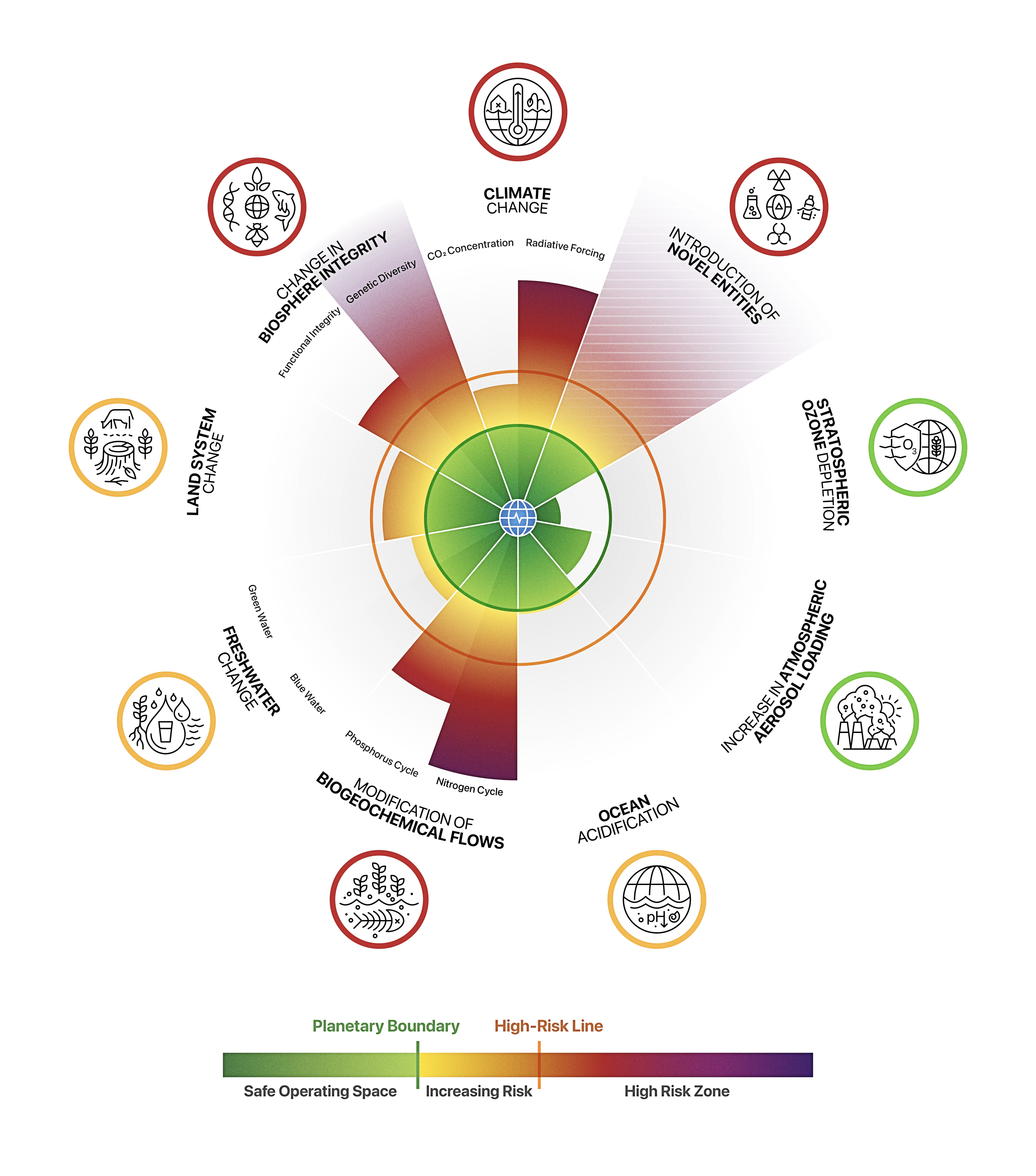
According to the Potsdam Institute for Climate Impact Research we have breached 7 of the 9 critical Earth system boundaries. There are only two that remain in safe zones – the Ozone Layer and Atmospheric Aerosol Loading. Human civilisation developed within an unusually stable Earth system. If we’ve pushed 7 of its 9 major life-support systems outside their scientifically assessed safe boundaries, we are progressively weakening the resilience of the planet we depend upon.
This means increasing the risk of cascading, potentially irreversible changes to climate, water, food systems and ecosystems. We’re back to global heating → drought → floods → failing harvests → food insecurity → displacement → conflict → mass extinction.
Source: Potsdam Institute – The Planetary Boundaries Science Lab at PIK finds that seven of nine critical Earth system boundaries have been breached, leaving only ozone depletion and aerosol loading within safe limits. (PIK, 2025)
We’re also experiencing ecological overshoot every year. We are constantly using more resources, more energy, producing and using more stuff. We are cannibalising the planet, using 1.73 times the resources the Earth can regenerate every year. This is not sustainable. The UK national ecological overshoot day this year was 22 May 2026.
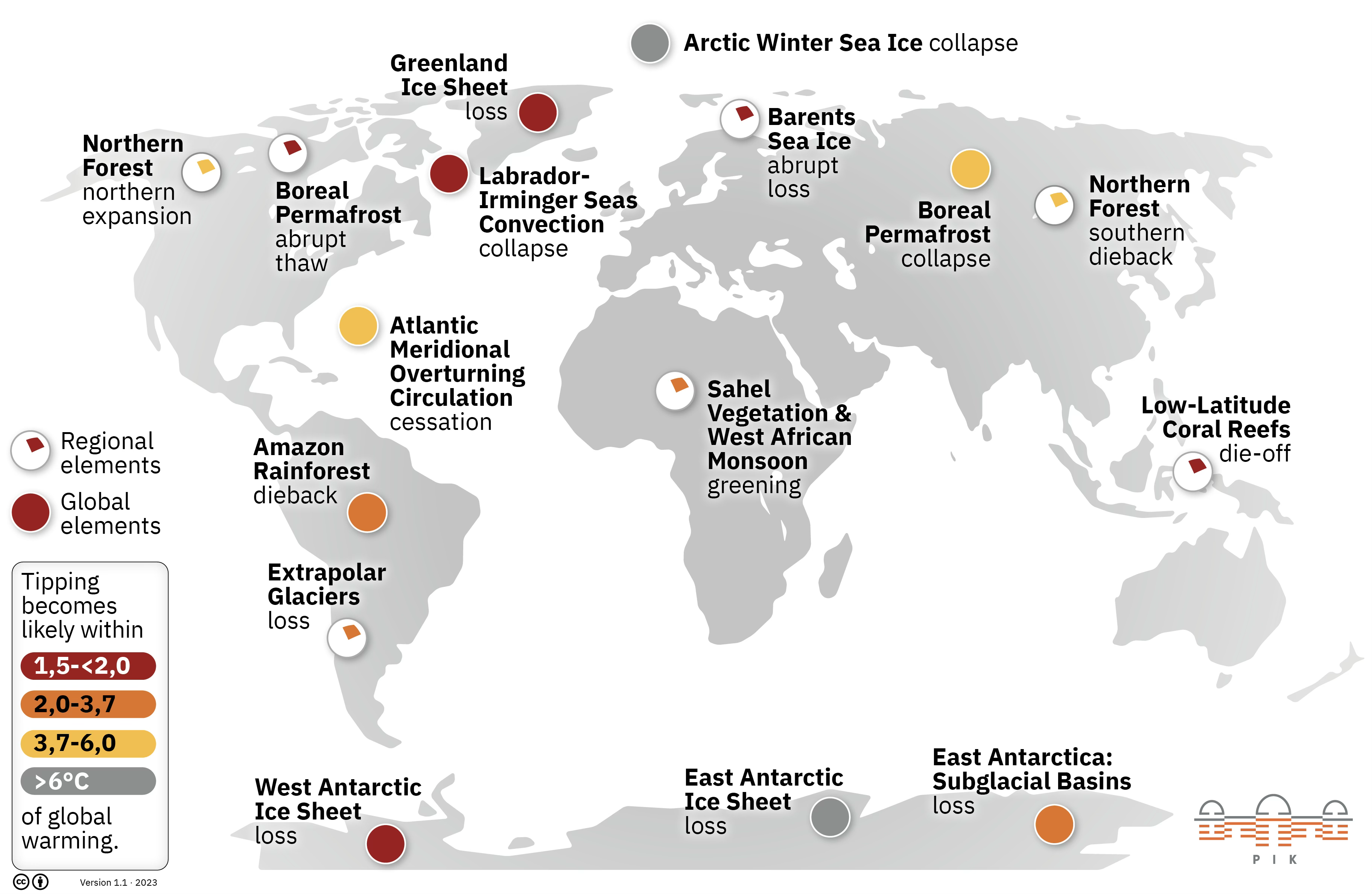
We are approaching, and in some cases may already be passing, critical tipping points. Coral reefs bleaching and dying. Albedos that reflect sunlight back into space are disappearing as ice melts. Permafrost is melting releasing methane into the atmosphere, a far more potent greenhouse gas than carbon dioxide. Parts of the Amazon rainforest are dying and becoming source of emissions rather than soak for carbon emissions. The oceans are hot, and as they heat up they absorb less carbon dioxide, becoming less effective as a carbon sink whilst they also acidify and become less sustainable for life. And of course wildfires are raging, destroying nature and carbon sinks, whilst emitting even more carbon dioxide into the atmosphere.
For all practical purposes, we’ve blown any realistic prospect of keeping long-term warming below 1.5°C without substantial overshoot. We are firmly on track for + 2°C, then potentially +3°C, even +4°C in more extreme modelling. The Paris Agreement didn’t define 2°C as safe. It tried to commit governments to keeping warming “well below 2°C” and pursuing 1.5°C because this would significantly reduce climate risks. The IPCC subsequently found that at 2°C the risks to food, water, health, livelihoods and human security rise substantially, with some impacts becoming widespread, severe and potentially irreversible.
Source: Potsdam Institute. The geographical distribution of global and regional tipping elements, color-coded according to the best estimate for their temperature thresholds, beyond which the element would likely be ‘tipped’. Figure designed at PIK (under cc-by licence), based on Armstrong McKay et al., Science (2022).
We’re already seeing more fires, droughts, and harvest failures. These are hitting especially hard where I live in Norfolk, UK. It’s going to get a lot worse, with more heat injuries and deaths, food and water shortages, floods, sea level rise, poverty, economic damage, rising inequality, war for remaining resources, and ecosystem collapse. We aren’t doing nearly enough to adapt as it is, and simply won’t be able to adapt to what is coming.
We have to stop greenhouse gas emissions, whilst also implementing adaption measures. And we need to do it now. This rhetoric from the government and fossil fuel industry we’re being programmed with, that we have to be pragmatic, that fossil fuels need to be in the energy mix for a long time yet – it’s a death sentence for billions.
The Institute and Faculty of Actuaries (IFoA), the people that inform the insurance industry, have warned there is a severe risk of a global death toll of billions of people. They have modelled a severe risk of 4 billion deaths at +3°C. This is them doing catastrophic-risk modelling, but we keep passing worst case scenarios. By the way, this model is scaled up for +2°C which predicts 2 billion dead. As things stand we have very little chance of staying under +2°C as emissions are still going up, and those emissions will impact temperatures for decades, centuries, locking in global heating to +2°C and beyond.
Politicians and oil and gas companies tout carbon capture and storage as the panacea. But it has not been built and therefore proven at scale, and will cost a fortune to build. It is not a get-out-of-jail-free card for continued oil and gas use. Why not spend that money on renewables, energy storage and grid upgrades. At the same time this would create thousands of jobs and give the economy a boost, whilst reducing emissions, lowering bills, and improving our energy security. What’s not to like?
The truth is still being hidden, by Governments – who have both their heads in the sand whilst hiding the facts. By large proportions of the billionaire owned press. By oil and gas companies who are doing the same as the tobacco industry, and have done for decades – hiding the science and truth in order to make sick amounts of money, at the expense of our health, of the Earth’s life support systems. And by banks and hedge funds who are funding it all.
Business as usual is killing us, and making a few people, an absolute minority, absurdly rich and powerful. But they won’t be able to buy their way out of the multiple crises that are both here right now or approaching fast. We cannot adapt our way out of some scenarios, it doesn’t matter how much money you have if the opposition keep putting more players on the pitch.
Here we are then. Our life support systems are failing, yet we are trying to keep calm and carry on. We are being betrayed, totally failed, by governments whose primary responsibility is to protect and serve their citizens. They in turn are being manipulated by lobbyists, oil and gas companies whose employees meet with ministers every day, by billionaires with no empathy and the media and corporations they control. Our political, economic, financial, industrial, legal, food and water, systems, and many more, are broken, not fit for purpose in the world we now live in.
We talk endlessly about national security and defence budgets – buying more bullets and bombs. But security also means flood defences, reservoirs, resilient food production and storage, secure clean energy, functioning ecosystems and homes for people displaced by climate impacts.
We won’t get these changes under the current system of government. It just can’t do it with the vested interests involved, and the governance processes it is bound by.
We have to act, for our own sakes as well as future generations. We need a peaceful revolution to make changes to all those systems.
Or we’re fucked.
I’ll leave you with this poem, which has been resonating with me a lot today.
Do not go gentle into that good night, Old age should burn and rave at close of day; Rage, rage against the dying of the light.
Though wise men at their end know dark is right, Because their words had forked no lightning they Do not go gentle into that good night.
Good men, the last wave by, crying how bright Their frail deeds might have danced in a green bay, Rage, rage against the dying of the light.
Wild men who caught and sang the sun in flight, And learn, too late, they grieved it on its way, Do not go gentle into that good night.
Grave men, near death, who see with blinding sight Blind eyes could blaze like meteors and be gay, Rage, rage against the dying of the light.
And you, my father, there on the sad height, Curse, bless, me now with your fierce tears, I pray. Do not go gentle into that good night. Rage, rage against the dying of the light.
I recently wrote to the BBC to complain about their coverage of the climate crisis, which I, and many others, believe remains woefully inadequate given the existential threats it poses. Below is the complaint I submitted.
Coverage of climate change
I’m writing to complain about the BBC’s inadequate coverage of today’s letter from the Climate Change Committee to Government on the UK’s preparedness for at least 2°C of global warming by 2050.
This is a matter of profound national importance, yet your main news programmes gave it little to no prominence. Such omission feels negligent at best, and at worst suggests a deliberate downplaying of vital information, whether due to editorial decisions, management influence, or political pressure. The public deserves transparency on issues that will shape our collective future. It is already known that Downing Street blocked a government report warning that the collapse of rainforests, reefs, and mangroves could raise food prices in UK supermarkets.
Earlier this year, the Institute and Faculty of Actuaries (IFoA) warned of escalating climate risks -more floods, fires, droughts, and ecosystem collapse. Their analysis projected GDP losses of up to 50% between 2070 and 2090, and warned that global heating of +3°C, possible as early as 2050, could cause over 4 billion deaths, societal collapse, and extinction events.
Despite the gravity of these findings, BBC reporting on the climate and nature crises remains inconsistent and insufficient. This undermines your stated purpose “to provide impartial news and information to help people understand and engage with the world around them.”
While I appreciate an article appeared on your website, this story should have led your main news bulletins, with clear context on what climate breakdown, mitigation, and adaptation mean for ordinary people. It would not have been difficult to feature credible climate scientists or policy experts.
I urge the BBC to give greater priority to the climate and nature crises, ensuring the public are properly informed and able to make meaningful democratic choices, particularly about which leaders and policies will act to safeguard our future and that of coming generations.
The CCC warns that the UK must urgently strengthen its adaptation objectives to protect food security, infrastructure, public services, the economy, and access to financial services such as insurance. Many properties are already becoming uninsurable due to flood risk.
We are beyond the stage where it’s possible to mitigate all catastrophic climate impacts. Yet the current levels of adaptation -and even the plans for adaptation – remain unambitious and wholly inadequate. Inadequate seems to be the word of the day when it comes to both government and media responses to the climate and nature crises.
This is the response from the BBC I received last night:
Dear Mr Harvey,
Thank you for getting in touch about BBC News at Ten on 15 October.
We’re sorry you feel insufficient coverage was given to the letter addressed to the government from the Climate Change Committee (CCC), warning that the UK should be prepared to cope with weather extremes as a result of at least 2C of global warming by 2050.
We know that not everyone will agree with our choices on which stories to cover, or the order in which they appear. Our news editors make these complex decisions, based on the editorial merit of all the stories at hand. We accept that not everyone will agree with each decision – various factors are at play and there’s often debate in the newsroom too.
BBC News did cover this across our news outlets however and you can read the online report here:
The BBC has been reporting on both the effects of climate change and the changes that individuals and governments can make in order to reduce carbon emissions for many years. In recent years these reports have had increased prominence as the evidence grows about the speed and impact of climate change.
To read our latest News on the issue of climate change, you may be interested in the following link:
We can assure you that the BBC is committed to providing fair and impartial coverage of the latest News stories to our audience, and climate change is an issue that the BBC takes very seriously.
We very much value your feedback. Complaints are sent to senior management and we’ve included your points in our overnight reports. These reports are among the most widely read sources of feedback in the BBC. This ensures that your concerns have been seen by the right people quickly, and helps to inform decisions about current and future content.
I appreciate that the complaints team forwards feedback to senior management, and I can only hope that the BBC – and the wider media – will soon recognise the urgency of reporting on the existential crisis that is climate breakdown.
This crisis threatens the lives and livelihoods of billions over the next 25 to 50 years — and millions are already being affected, displaced, and killed by its impacts. It demands coverage that reflects its true urgency, accuracy, and frequency.
I’d be very interested to hear what others think — please feel free to leave a comment or share your perspective below.
It’s spring again, after yet another wet and windy winter. I’d better go out and feed the chickens, but can’t say I feel particularly motivated to do so, not with the rain lashing against the window, sending muddy streams of water running down the hill to the already swollen river.
At least we don’t live in the village, that’ll be flooded again. I’m surprised more people haven’t moved, but I guess folks are clinging on to what they can these days. Maybe I’ll trade the last orange with the kids, as payment for doing the morning chores; we don’t see much in the way of oranges, and haven’t done for several years now, not since the new laws came in around carbon footprints. As for bananas, the children have never had one, they got wiped out by some new fungus that couldn’t be eradicated in time to save the plantations, and they’d be too far away to transport now anyway.
Still, life is pretty good, all things considered and despite the lack of exotic foodstuffs. There’s definitely more of a community spirit, and healthier lifestyles going on, both mentally and physically. Sod it, I’ll save the orange for later.
I bang on the kid’s bedroom door to wake them from their respective slumbers, and put on my boots, heading out into the rain as the sun rises behind the clouds, and the neighbours ever hopefully cockerel welcomes in the new day. The constant whirring of the wind turbine supplying power to both our house, and those of several neighbours, reminds me that I should check the solar panels soon, now that we’ve more daylight they’ll need cleaning. There’s a lot more renewable energy now, with the ban on most fossil fuel burning in place. We’ve enough power for everything we need, unless it’s really cloudy and there’s no wind for an extended period. As long as the kids have an internet connection they’ll be happy, but I ration them to an hour online a day, aside from school, to make sure they have time for chores and learning skills that’ll be important should things deteriorate.
So much has changed in the last 30 years, and so quickly, faster than any of the scientists were predicting, or willing to predict anyway. The CO2 levels in the atmosphere rocketed, due to warming oceans soaking it up less and less, more being released from vast areas no longer locking greenhouse gases away under a permafrost layer, and humankind’s continued thirst for cheap and dirty energy. A few big and unexpected volcanic eruptions didn’t help either, although they did remind people we can’t control everything. We reached a tipping point where global temperature rises were locked in, and are still locked in despite a massive reduction in carbon emissions. In the space of about 20 years the big glaciers in the Arctic Circle had all but melted, causing sea levels to rise dramatically, and huge areas to be flooded; the Norfolk coastline certainly changed, however at least we’re still above water, unlike swathes of Bangladesh and India, the Maldives, and countless other areas around the world.
I let the chickens out, make sure they’ve got enough grain, then do the rounds to check everything is in order, the pigs are happy, and nothing’s been stolen overnight. We don’t have much trouble nowadays, compared with 10 years ago, but there’s still the odd band of desperate people about, those without a home or means to contribute enough in return for food. All’s well and I head back inside hoping Danny and Jess have got breakfast ready.
The altered climate brought with a whole host of challenges. Some areas had too much water, whilst other suffered from extended drought, causing huge population migrations. War had been the motivating factor before, however now climate change took over. Then things got really bad, with economic meltdowns in China and the US sending everyone else down the tube. This led to more unrest, with richer countries no longer able to help out those most in need, or unwilling to do so with so many issues on the home front. Borders started closing, but this didn’t stop huge numbers of people streaming into Europe from the Middle East and Africa. The dystopian future people had feared would happen started to become a reality, with fascism on the rise in many countries, and vicious crackdowns on anyone threatening to further destabilise already precarious governments. The UK, by virtue of the English Channel, was spared a lot of the problems that hit France, Germany and Scandinavia, especially after some radicals blew up the Channel Tunnel; no mean feat considering it was meant to be relatively bomb proof.
Danny and Jess are up and already half way through their breakfasts by the time I’ve shaken the water off my coat and sat down at the table. We chat about who’s doing what today as we munch our way through eggs and bacon, with a few rounds of toast for good measure. I’ll need to go and restock on butter from the farm down the road again soon, and we’re nearly out of jam, with a few months until we can make any more. My wife Cassy used to make the best jam, but she passed away a few years ago, one of the last to die of the Snow virus before a vaccine was made widely available. Danny and Jess will work on their schooling this morning, before helping out in the workshop this afternoon. I leave them to clear up breakfast and head there myself, keen to finish fixing up a couple of biofuel generators that have been on my to do list for the last month, and which the mayor chased me up on yesterday.
I think about Cassy, as I often do, as I get to work cleaning the generator alternators. I miss her so much, but life goes on and I still have Danny and Jess; I’m fortunate compared to so many others. Rising global temperatures and melting ice didn’t just cause sea level rises and intense storms, we got hit by diseases no one was expecting. It started with the Zika virus spreading like wildfire, and then a whole load of other outbreaks as vector numbers and their viable habitats increased. We saw more Ebola due to a deterioration in sanitation in parts of Africa, but the Snow virus was the worst. Scientists reckon it was something locked away in the ice that thawed and went airborne, infecting masses before a vaccine could be created. Survival rates were low, and death not pretty, with funeral pyres lighting up the countryside for miles. The latest stats estimate over 70% of the world population perished due to Snow, with outbreaks still happening in some remote areas; I guess that’s solved the overpopulation crisis. Weirdly Russia seems to have done a lot better than other countries, and there are more than a few conspiracy theories suggesting why that might be, however it might just be that they were more prepared to take drastic measures to look after their own.
I finish the generators, grab lunch with Danny and Jess who as usual seem determined to explain why learning algebra isn’t going to help with anything, then we all head back to the workshop to continue working on the tram components needed for the new network in Norwich; self-drive systems I have the knowhow to build, and which Danny and Jess can help with, sort of, they’re learning anyway, and I’ll get them working in the vegetable patch if they get bored.
It’s great we have power to run things like trams, and electric vehicles, as well as our homes. We didn’t a few years ago when huge storms wiped out a lot of the off-shore turbines; higher sea levels, and massive storm driven waves aren’t kind to turbine blades. Some places started to use old petrol and diesel generators again, but that didn’t last long, with a violent backlash from many who saw such things as the cause of all our problems, and rightly so might I add (just in case the Environment Ministry is reading this). How could the human race continue using resources that are essentially dooming us, for so long, ever since the industrial revolution…bastards…why didn’t they just think a bit more about the future and their children, instead of being so unwilling to make even the slightest change to their excessive lifestyles. We’ve got fusion coming online now, finally. We should no doubt have put more effort into developing it sooner, but hindsight is a wonderful thing. Fusion is going to take a few more years to roll it out across the country, however once it’s in place we’re sorted energy wise, and the last of the nuclear plants can finally be shut down for good, getting rid of another threat to the world’s future.
We knock off an hour before dusk, after a productive day on all counts, even if Danny did fall out of an apple tree trying to retrieve the drone he’d accidentally flown into its branches. They shouldn’t have been playing with it anyway, but I let that pass; they’re good kids for the most part, and I’m conscious they don’t get as much time to just be kids as they should. Over supper we watch the latest news reports, which aren’t all doom and gloom, despite more severe weather warnings as the persisting El Nino effect and disrupted Jet Stream send more storm fronts our way; nothing new there. There’s a great documentary on how marine life has recovered in the last 15 years, since the genocidal fishing fleets were put out of action, and demand fell due to a reduced population. It reminds me we should head up to the coast, not as far away as it used to be, to enjoy some fresh crab and restock on smoked fish. Although we don’t have all the food luxuries that were ever-present 30 years ago, we’re pretty well off now, and even have an abundance of some things, such as vegetables and meat, although we try not to eat too much of the latter. It was bad for a while, with anarchy reigning when food shortages hit and things collapsed, but we got there in the end.
We wash up and ensure any waste is assigned to the relevant pod for recycling, not that there’s much waste these days with packaging made illegal, and people taking their own containers and bags to pick up food or goods from merchants or the government-run outlets. That’s another thing that’s hard to believe nowadays; how could people in the 20th and early 21st century be so wasteful? We’ll be living with a legacy of plastic bottles for millennia to come, but at least we can reuse them for various things, and very few are produced new now due to the restrictions.
After dinner, and for a bit of fun, we take the electric motorbikes out for a scramble around the nearby forest track, wearing our light enhancing goggles to avoid crashing on the way there. We enjoy seeing who can perform the most outrageous stunts around the solar storage lighted track, and as usual Jess wins; she’s no fear that girl. After a chat with the neighbours on the way back, who are out for a horse ride and like us enjoying a break in the rain, we all plug-in to the Net for an hour before bed, surfing our way through games, adventures, social media or news, whatever takes our fancy, and occasionally interacting with each other, far away friends or relatives as we float disembodied in the ether; I can see why some people were tempted to go fully virtual.
Then some alone time. Jess and Danny are in bed. I sit by the wood burning stove which I’ve lit as a luxury, burning a few kilograms of our wood allowance, and reflect. We’ve made it, things are looking up for the human race now, as long as we remember lessons learned. A tear tracks down my face as my thoughts turn to Cassy, and all the others we’ve lost, including my parents, early victims of the Climate Riots. Yes, we’ve made it, Danny and Jess have a future, and as long as we continue to strive to live in harmony with Earth, rather than exploiting and abusing it and each other, we stand a good chance. There’s still the threat that the climate changes we’ve locked in will throw us some curve-balls, or the odd country might go rogue and contravene the Earth agreement; Russia still worries a lot of us, but we’re getting there. I wonder what our parents, grandparents, great grandparents would have changed if they could have only seen us now.
Interesting to write, and think about what life could really be like in the not to distant future. If not by 2050, then within the next few hundred years. It’s fascinating to think about how things could change, quite quickly, for the worse in the short-term, but better in the longer term, with sustainable policies coming into effect, and the human race living in parallel rather than perpendicularly to the rest of the planet, and technological advances still benefiting us. Of course I haven’t mentioned a zombie apocalypse, but I’ll save that blog post for another day.
Now if only everyone would really think about this, and the challenges ahead, and make changes before we’re forced to by circumstance.