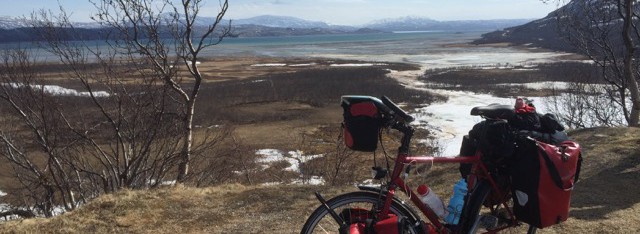
This morning I am grateful for last night’s rain, bringing relief to the countryside, plants and animals, humans included. Because we are animals, with the same fundamental needs all animals have – shelter, water and food. We seem to have forgotten that.
We’ve forgotten that without a stable ecosystem and environment to live in, our existence is compromised. Instead, at least in wealthier countries, we often prioritise non-essentials, things we want but don’t actually need – new tech, expensive clothes and cars, holidays abroad, subscriptions to TV and other digital services – all stuff that are nice to haves but not essential to being alive, being happy, or being healthy.
We are a part of nature, not apart from it. Our lifestyles, driven by the media, advertising and mega-corporations harvesting our earnings to get even richer, are not compatible with a sustainable present, let alone future. We are trained from a young age to be good little consumers, that one’s success is measured by how much stuff you have, how much money, not by the community you are in and shared experiences, support for one another, connections, kindness and empathy.
Indeed, the latest attack by some right wing figures is on empathy. Apparently it’s a bad thing – caring is bad, don’t care about other people or nature, that’s weak. Much better to live a hedonistic, selfish lifestyle, if you are following the parables of Musk. What an absolute bell-end.
According to the Potsdam Institute for Climate Impact Research we have breached 7 of the 9 critical Earth system boundaries. There are only two that remain in safe zones – the Ozone Layer and Atmospheric Aerosol Loading. Human civilisation developed within an unusually stable Earth system. If we’ve pushed 7 of its 9 major life-support systems outside their scientifically assessed safe boundaries, we are progressively weakening the resilience of the planet we depend upon.
This means increasing the risk of cascading, potentially irreversible changes to climate, water, food systems and ecosystems. We’re back to global heating → drought → floods → failing harvests → food insecurity → displacement → conflict → mass extinction.
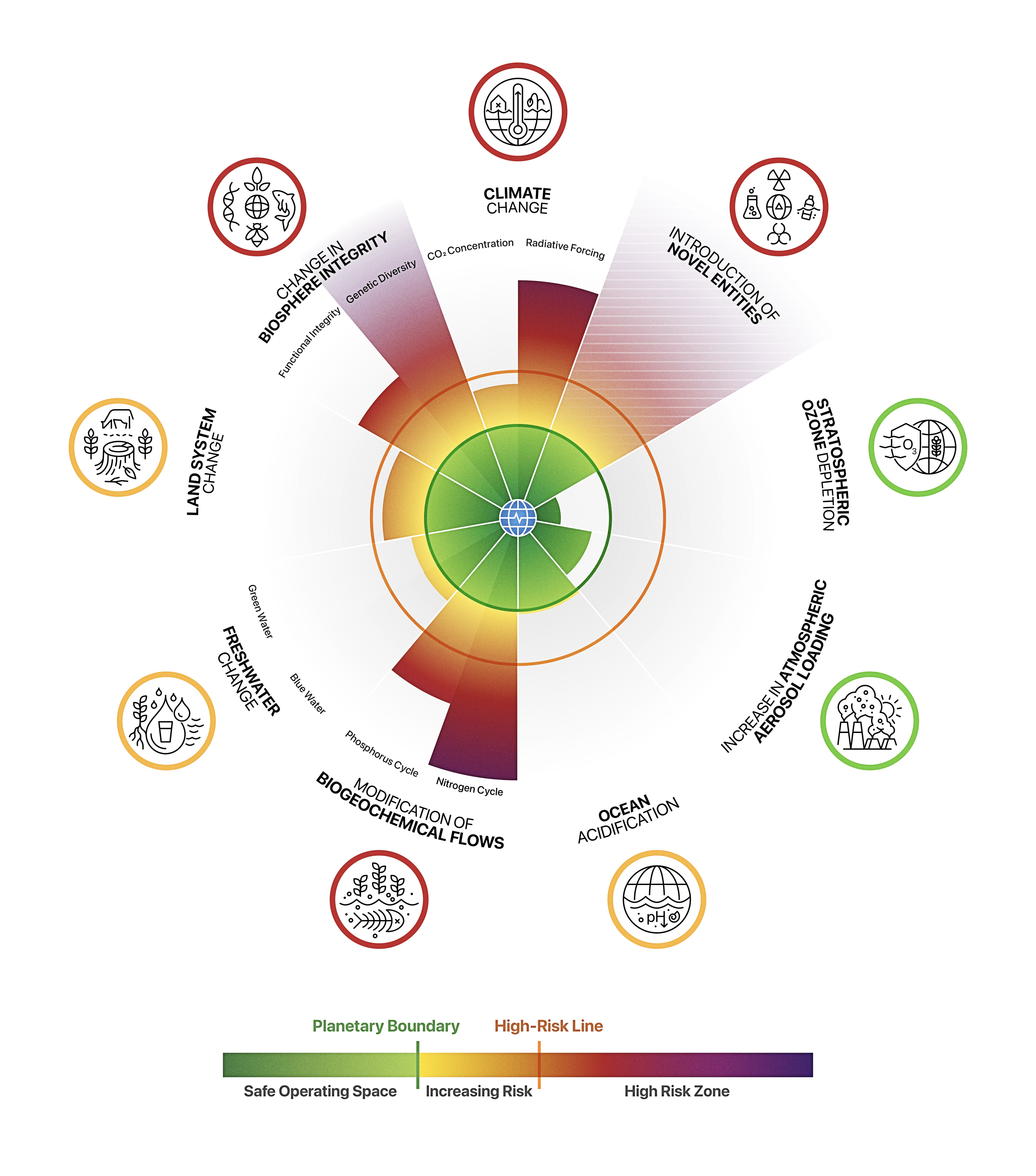
Source: Potsdam Institute – The Planetary Boundaries Science Lab at PIK finds that seven of nine critical Earth system boundaries have been breached, leaving only ozone depletion and aerosol loading within safe limits. (PIK, 2025)
We’re also experiencing ecological overshoot every year. We are constantly using more resources, more energy, producing and using more stuff. We are cannibalising the planet, using 1.73 times the resources the Earth can regenerate every year. This is not sustainable. The UK national ecological overshoot day this year was 22 May 2026.
We are approaching, and in some cases may already be passing, critical tipping points. Coral reefs bleaching and dying. Albedos that reflect sunlight back into space are disappearing as ice melts. Permafrost is melting releasing methane into the atmosphere, a far more potent greenhouse gas than carbon dioxide. Parts of the Amazon rainforest are dying and becoming source of emissions rather than soak for carbon emissions. The oceans are hot, and as they heat up they absorb less carbon dioxide, becoming less effective as a carbon sink whilst they also acidify and become less sustainable for life. And of course wildfires are raging, destroying nature and carbon sinks, whilst emitting even more carbon dioxide into the atmosphere.
For all practical purposes, we’ve blown any realistic prospect of keeping long-term warming below 1.5°C without substantial overshoot. We are firmly on track for + 2°C, then potentially +3°C, even +4°C in more extreme modelling. The Paris Agreement didn’t define 2°C as safe. It tried to commit governments to keeping warming “well below 2°C” and pursuing 1.5°C because this would significantly reduce climate risks. The IPCC subsequently found that at 2°C the risks to food, water, health, livelihoods and human security rise substantially, with some impacts becoming widespread, severe and potentially irreversible.
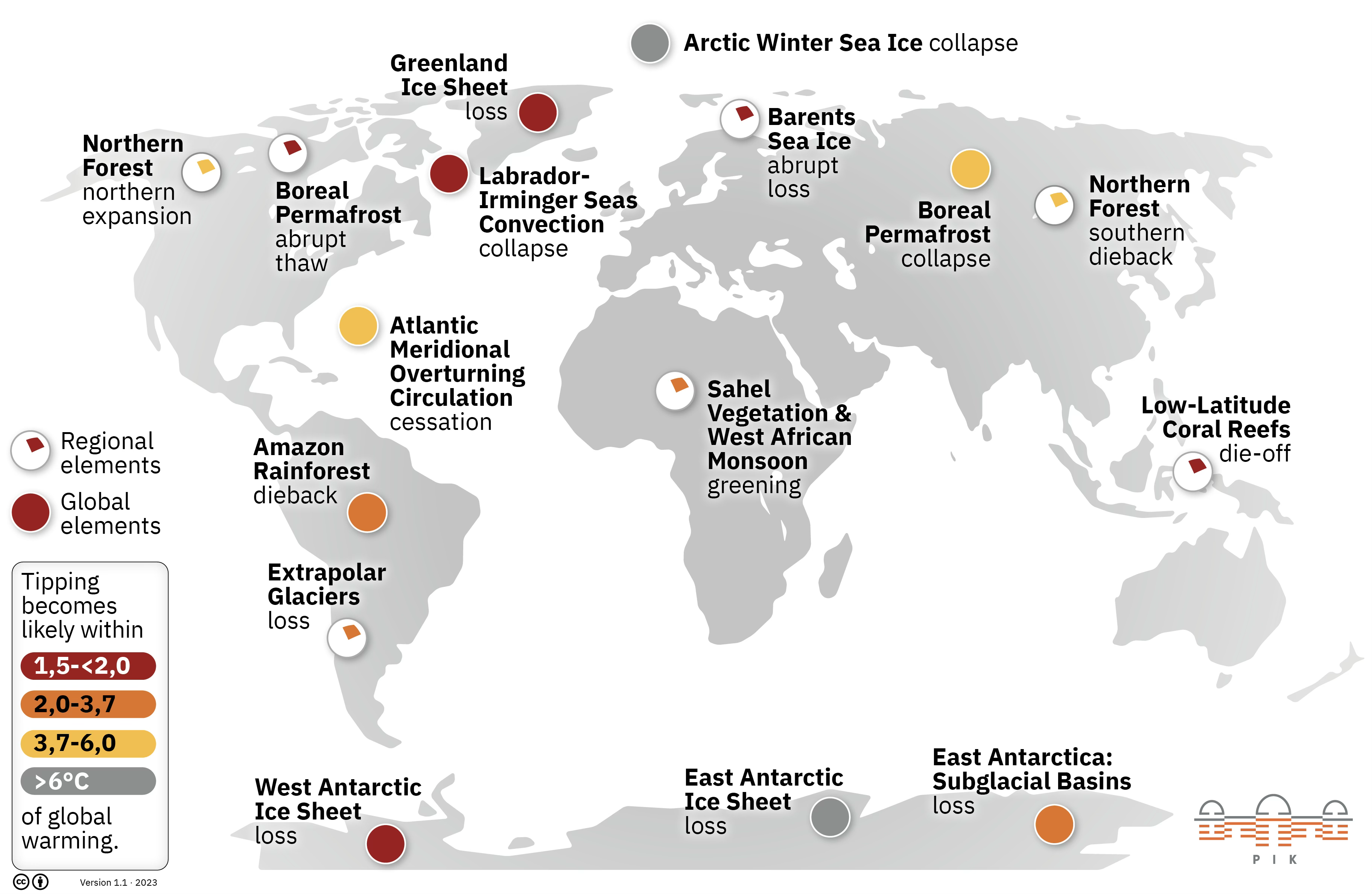
Source: Potsdam Institute. The geographical distribution of global and regional tipping elements, color-coded according to the best estimate for their temperature thresholds, beyond which the element would likely be ‘tipped’. Figure designed at PIK (under cc-by licence), based on Armstrong McKay et al., Science (2022).
We’re already seeing more fires, droughts, and harvest failures. These are hitting especially hard where I live in Norfolk, UK. It’s going to get a lot worse, with more heat injuries and deaths, food and water shortages, floods, sea level rise, poverty, economic damage, rising inequality, war for remaining resources, and ecosystem collapse. We aren’t doing nearly enough to adapt as it is, and simply won’t be able to adapt to what is coming.
We have to stop greenhouse gas emissions, whilst also implementing adaption measures. And we need to do it now. This rhetoric from the government and fossil fuel industry we’re being programmed with, that we have to be pragmatic, that fossil fuels need to be in the energy mix for a long time yet – it’s a death sentence for billions.
The Institute and Faculty of Actuaries (IFoA), the people that inform the insurance industry, have warned there is a severe risk of a global death toll of billions of people. They have modelled a severe risk of 4 billion deaths at +3°C. This is them doing catastrophic-risk modelling, but we keep passing worst case scenarios. By the way, this model is scaled up for +2°C which predicts 2 billion dead. As things stand we have very little chance of staying under +2°C as emissions are still going up, and those emissions will impact temperatures for decades, centuries, locking in global heating to +2°C and beyond.
Politicians and oil and gas companies tout carbon capture and storage as the panacea. But it has not been built and therefore proven at scale, and will cost a fortune to build. It is not a get-out-of-jail-free card for continued oil and gas use. Why not spend that money on renewables, energy storage and grid upgrades. At the same time this would create thousands of jobs and give the economy a boost, whilst reducing emissions, lowering bills, and improving our energy security. What’s not to like?
The truth is still being hidden, by Governments – who have both their heads in the sand whilst hiding the facts. By large proportions of the billionaire owned press. By oil and gas companies who are doing the same as the tobacco industry, and have done for decades – hiding the science and truth in order to make sick amounts of money, at the expense of our health, of the Earth’s life support systems. And by banks and hedge funds who are funding it all.
Business as usual is killing us, and making a few people, an absolute minority, absurdly rich and powerful. But they won’t be able to buy their way out of the multiple crises that are both here right now or approaching fast. We cannot adapt our way out of some scenarios, it doesn’t matter how much money you have if the opposition keep putting more players on the pitch.
Here we are then. Our life support systems are failing, yet we are trying to keep calm and carry on. We are being betrayed, totally failed, by governments whose primary responsibility is to protect and serve their citizens. They in turn are being manipulated by lobbyists, oil and gas companies whose employees meet with ministers every day, by billionaires with no empathy and the media and corporations they control. Our political, economic, financial, industrial, legal, food and water, systems, and many more, are broken, not fit for purpose in the world we now live in.
We talk endlessly about national security and defence budgets – buying more bullets and bombs. But security also means flood defences, reservoirs, resilient food production and storage, secure clean energy, functioning ecosystems and homes for people displaced by climate impacts.
We won’t get these changes under the current system of government. It just can’t do it with the vested interests involved, and the governance processes it is bound by.
We have to act, for our own sakes as well as future generations. We need a peaceful revolution to make changes to all those systems.
Or we’re fucked.
I’ll leave you with this poem, which has been resonating with me a lot today.
Do Not Go Gentle into That Good Night
BY DYLAN THOMAS
Do not go gentle into that good night,
Old age should burn and rave at close of day;
Rage, rage against the dying of the light.
Though wise men at their end know dark is right,
Because their words had forked no lightning they
Do not go gentle into that good night.
Good men, the last wave by, crying how bright
Their frail deeds might have danced in a green bay,
Rage, rage against the dying of the light.
Wild men who caught and sang the sun in flight,
And learn, too late, they grieved it on its way,
Do not go gentle into that good night.
Grave men, near death, who see with blinding sight
Blind eyes could blaze like meteors and be gay,
Rage, rage against the dying of the light.
And you, my father, there on the sad height,
Curse, bless, me now with your fierce tears, I pray.
Do not go gentle into that good night.
Rage, rage against the dying of the light.