All around me are familiar faces
Worn-out places, worn-out faces
Bright and early for their daily races
Going nowhere, going nowhere
Their tears are fillin’ up their glasses
No expression, no expression
Hide my head, I wanna drown my sorrow
No tomorrow, no tomorrow
….the Gary Jules version
Over the last couple of weeks I’ve been thinking a lot about risks. Actually, that’s a lie, I’ve been thinking about these sorts of risks for years. It’s quite tiring. Regard that last sentence as British reservedness.
As a project manager, I’m trained to identify what could go wrong, how likely it is, how serious the consequences would be, how risks interact, and what you can do to mitigate, resolve, or in some cases review if we should accept them.
I’ve been wondering what a global risk register would look like, and what the consequences are when you pull them all together.
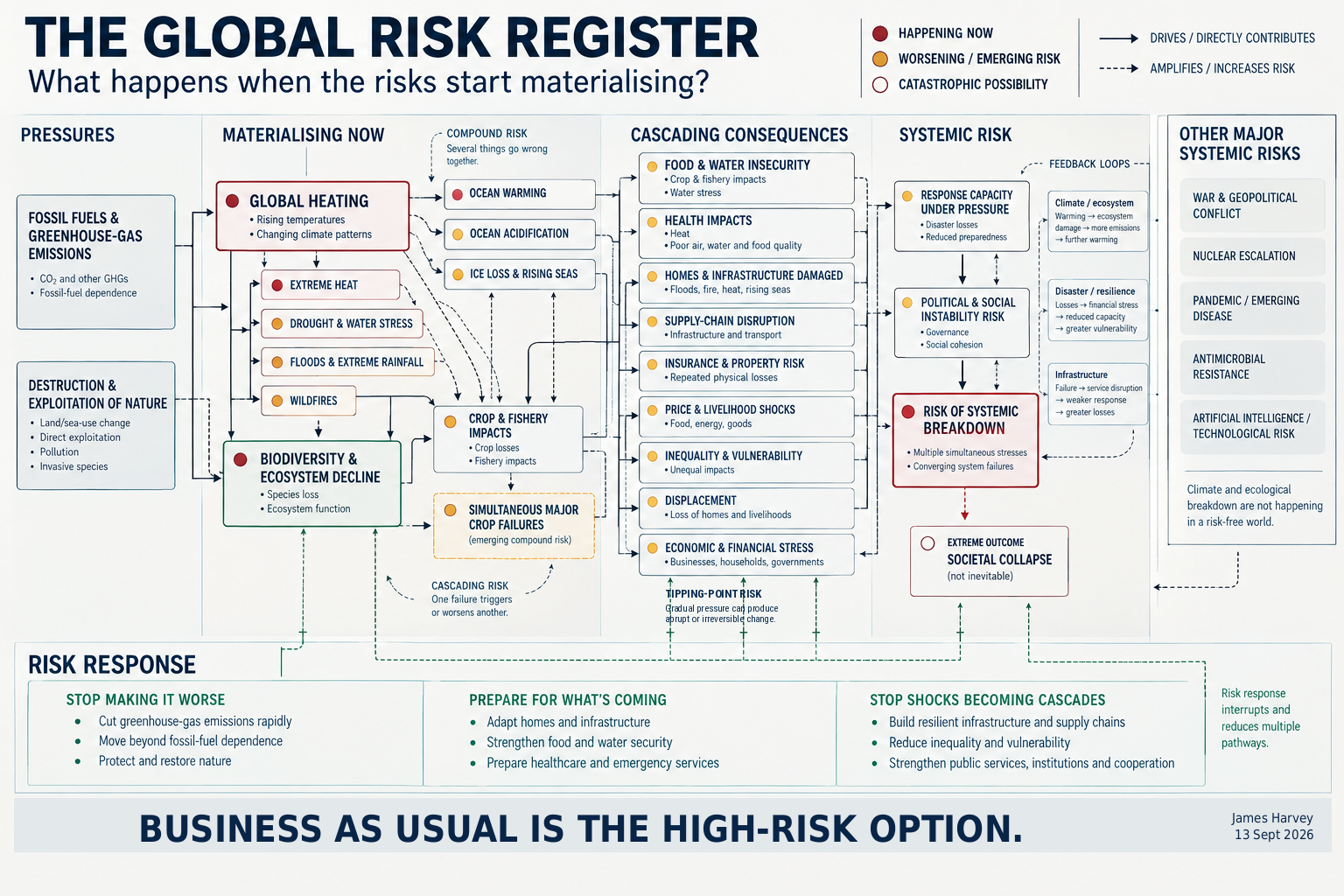
I’ve stared at this a lot since finishing it. Wondering if I missed anything, or if I’ve exaggerated any of the risks or consequences. If anything it’s probably conservative, as I’ve tried to stick to peer-reviewed science and analysis. One could argue that matters are, in fact, a lot worse. Talk to climate scientists away from the careful language of papers and reports and, in my experience at least, some will tell you just how frightened they really are.
I’ve not put a particular timeline against this, other than some of the boxes are already happening. Personally, I find it increasingly difficult to see how we avoid the systemic breakdown box on our current trajectory. I don’t know when, and I still think we have options. Options are important.
It’s not a very pleasant diagram. Not because every risk shown here will materialise at its worst. They won’t, probably. But some already have. Others are becoming more likely or more severe. And, crucially, they are not independent. Heat affects food. Floods affect infrastructure. Infrastructure affects supply chains. Disasters affect insurance and public finances. Food and housing costs affect poverty and inequality. Those stresses affect societies’ ability to cope with the next crisis.
I added a box on the right hand side too. Other major systemic risks. Because we are facing a multitude of potential catastrophes – I am sure I’ve missed some, feel free to add to the list – we also face war, nuclear escalation, pandemics, antimicrobial resistance and rapidly developing artificial intelligence. I felt like I should add patriarchy, but that’s more a cause than a symptom.
This is the worst risk register I’ve ever looked at. I don’t know how we can start to manage it. If this were any other project, would we really look at it and conclude that business as usual was the safe option? But that’s often the funny thing about risk registers, project managers wave them in front of their sponsors, and they often don’t really look at them, don’t really register or feel what they could mean in terms of successful outcomes. Then, unsurprisingly, projects are often delayed, collapse, or change far beyond their initial remit – I am sure many project managers can empathise.
I should add – I’ve seen many excellently run and delivered projects, at least a couple of them by my good self. They work really well when stakeholders and the project team are engaged and understand what is happening, what the risks and issues are, and what they need to do to help ensure delivery is a success. I maintain that project management, really, is about making lists, effective communication, and nagging.
Back to the diagram. I can create a risk register. Put it in colourful boxes. Draw arrows between the boxes. Find sources for every claim. Make sure every arrow can be defended.
But I can’t put on the diagram what knowing all this makes me feel.
That is, perhaps, the most important bit. People can be good at reading stuff, analysis, reaching conclusions, and they can also be rubbish at it. They can also forget facts and stuff they’ve read quite quickly. I do it all the time as a project manager – I move from one delivery to another, and once one is done I file it in my mind, find myself remembering the high level bits, but the detail is gone after around 3 months because I’ve had to move on something else.
Facts are capricious. Easily forgotten or laid aside in favour of something more current. Like Harry and Meghan. Or Farage. Or Eastenders. We are a wonderfully distractable species and our media and politicians know it.
What aren’t so forgettable, or deletable, are feelings, emotions. A diagram doesn’t necessarily invoke feelings, although this one did for me. A song, a smell, a picture, can all invoke powerful memories that are retained for a lifetime. A diagram doesn’t do that. Strong emotions, felt at a particular event, tied to sensory inputs, have, I think, a far greater chance of being retained.
I think people need to feel these risks. Sadly, many already have as they materialise into regional issues – smoke from fires, hunger in the belly, a parched throat, being engulfed by flood waters, mud, or rockslides, grief at a lake or river dying, a forest or a glacier disappearing, or another animal going extinct.
Feeling is so important. I think only when we really feel what is happening are we motivated to change course. I am talking about when things really matter – health, survival, future generations, survival – food, shelter, warmth.
It makes me frightened. It makes me angry. Often it makes me despair. Because we know what is happening. We know what we need to do. And still we carry on. We let our elected leaders, corporation bosses, billionaires, carry on. ‘Keep calm and carry on’ …screw that.
Can you feel the rage, the grief? Born out of love, but also just, fucking, rage, that we are and have been led to this place. A place where nature is dying – I saw thousands of dead fish floating in the Wensum the other day but it’s alright as Anglian Water shareholders are doing okay – people are dying, especially in the Global South – see Nepal, India, Pakistan, Bangladesh, Tanzania, Zambia, Libya, Zimbabwe, even the USA, although it is better endowed to cope with such events. Is this alright? I guess it is if you just see it on TV or in a newspaper, but what if you actually feel it, and what it could mean for you and people you care about?
I feel it. Every single day. My activist friends – and I hate calling them activist friends, they’re people that just deeply care and can’t stand by – they feel it. Every. Single. Day.
Actually, a lot of religious leaders feel it and have called out that we need to do something, urgently, including the Pope I think. I am sure a lot of charities feel it, as demands on their dwindling resources grow. And some political leaders do, including António Guterres, and a few others. Not many, sadly.
One can present a table of risks, or consequences. One can publish such a thing in countless scientific journals, newspapers, books. But unless people emotionally connect with what is happening, and aren’t anaesthetised by the drugs of social media and TV, we aren’t going to have the revolution – preferably non-violent and accountable – that is needed.
I take action because action gives me hope. XR and Just Stop Oil gave me hope. Defend Our Juries gives me hope. Seeing people sitting in a road with other ordinary people and refusing to cooperate with something profoundly wrong gives me hope. But increasingly I find myself asking whether actions involving tens, hundreds, even thousands of us can possibly force change on the scale now required.
Perhaps we need millions. Not just in the UK. Globally.
It is, after all, a minority of the super rich and powerful, and the vested interests they benefit from and protect, that are disproportionately driving so much of this – climate breakdown, biodiversity collapse, grotesque inequality, hunger, thirst, the sixth mass extinction…I could go on.
Perhaps we need to stop.
Actually stop.
Not a march on a Saturday afternoon. Not another pointless petition. Not another consultation. Not another promise that if we vote differently in four years’ time things might get better.
Workers stop working. Offices empty. Trains stop. Deliveries stop. Shops close. Production stops. The machinery of business as usual stops. Just Stop.
Hospitals keep caring for people. Carers keep caring. Firefighters respond to fires. Essential services necessary to protect life continue.
But everything else?

A general strike, on a scale that cannot be ignored.
Because political and economic power ultimately depends upon millions of ordinary people continuing to cooperate with it. We work. We produce. We buy. We move things. We keep institutions functioning. We make other people rich.
What happens if, together, we withdraw that cooperation? Perhaps it could start in the UK. Perhaps elsewhere. Perhaps everywhere. Because ordinary people across the world mostly want the same basic things: safety, food, shelter, family, friendship, love, a future.
And yes, this will likely mean lifestyle changes. It will mean accepting that we can’t have all the things we wanted, and that our futures are going to be quite different from what we anticipated. But at least we’ll be alive, and our children will have a chance of a future.
We could even be happier and healthier, with better communities and greater connection.
Surely survival is the priority? Not war. Not greed. Not GDP. Not AI. Not the space race.
What happens if we say: not again until you deal with this?
No more HARM.
Options are important. We still have them. We can stop making things worse. We can prepare for what is already coming. We can protect each other. Restore nature. Build stronger communities. Stop cooperating with systems that are causing so much harm.
None of that guarantees everything will be okay. It won’t be. That’s not how risk works.
But business as usual is an option too.
It’s the high-risk option.
Just. Fucking. Stop.
And sorry, project manager mode, here’s the table I pulled together to inform the risk diagram that people will forget, but hopefully they’ll remember the rage, grief, and love.
| Risk / issue | Status | Direction | Potential severity | What it can lead to / amplify | Evidence and current assessment |
| Greenhouse-gas emissions / fossil-fuel dependence | HAPPENING NOW | ↑ | Very high | Further heating; ocean warming; sea-level rise; extremes; tipping risks | UNEP’s 2025 assessment puts current-policy warming at about 2.8°C this century, with full implementation of current Nationally Determined Contributions at about 2.3–2.5°C. (UNEP – UN Environment Programme) |
| Global heating | HAPPENING NOW | ↑ | Very high | Heat; drought; heavy rainfall; fire; ecosystem damage; food/water stress | WMO reports 2015–2025 were the hottest 11 years observed and 2025 was about 1.43°C above 1850–1900. (World Meteorological Organization) |
| Extreme heat | HAPPENING NOW | ↑ | Very high | Mortality; illness; labour losses; crop stress; infrastructure/energy pressure | WHO says exposure is growing in every region; mortality among over-65s increased about 85% between 2000–04 and 2017–21, with studies estimating about 489,000 heat-related deaths annually during 2000–19. (World Health Organization) |
| Drought & water stress | HAPPENING NOW | ↑ | Very high | Crop loss; ecosystem damage; water insecurity; livelihood losses; displacement | IPCC finds concurrent heat and drought already causing crop-production losses and tree mortality, with compound risks increasing as warming rises. (IPCC) |
| Floods & extreme rainfall | HAPPENING NOW | ↑ | Very high | Mortality; displacement; infrastructure/property damage; supply disruption | IPCC finds concurrent and repeated hazards are already increasing impacts on infrastructure, health, livelihoods and food, with risks cascading across sectors. (IPCC) |
| Wildfire / dangerous fire weather | HAPPENING NOW | ↑ | High–very high | Mortality; smoke exposure; ecosystem loss; property loss; carbon release | IPCC assesses wildfire and other extremes as part of increasingly interacting and compound climate risks. (IPCC) |
| Ocean warming & marine heatwaves | HAPPENING NOW | ↑ | Very high | Coral mortality; marine ecosystem disruption; fishery impacts | WMO reports continuing ocean warming and a growing planetary energy imbalance; the ocean also continues absorbing carbon dioxide. (World Meteorological Organization) |
| Ocean acidification | HAPPENING NOW | ↑ | High–very high | Coral/shell-former damage; food-web disruption; fisheries risk | Ocean acidification is a direct consequence of additional atmospheric carbon dioxide absorbed by the ocean, and interacts with warming and other marine pressures. WMO continues to track it as a major global climate indicator. (World Meteorological Organization) |
| Glacier & ice loss | HAPPENING NOW | ↑ | Very high | Sea-level rise; freshwater/hydrological changes; long-term irreversible losses | IPCC finds continuing substantial glacier loss; Greenland and Antarctic ice sheets are losing mass and long-term loss increases strongly with sustained warming. (IPCC) |
| Sea-level rise | HAPPENING NOW | ↑ | Very high | Coastal flooding; erosion; salinisation; displacement; infrastructure/property loss | IPCC assesses sea-level rise as effectively irreversible on centennial timescales, with ice-sheet behaviour creating additional long-term risk. (IPCC) |
| Biodiversity & ecosystem decline | HAPPENING NOW | ↑ | Very high | Loss of pollination, fisheries, carbon storage, water regulation and ecosystem resilience | IPBES’s Nexus Assessment explicitly treats biodiversity, water, food and health as interconnected systems rather than isolated environmental issues. (IPBES ICT) |
| Earth-system / ecological tipping points | WORSENING / EMERGING RISK | ↑ | Potentially catastrophic | Abrupt or irreversible ecosystem/climate change; additional warming; long-term sea-level rise; regional climate shifts | IPCC defines tipping points as critical thresholds beyond which systems reorganise, often abruptly and/or irreversibly, and finds their likelihood and impacts increase with warming. Large-scale singular risks move into high risk around 1.5–2.5°C in AR6. (IPCC) |
| Warm-water coral reef collapse | HAPPENING NOW / possible tipping transition | ↑ | Very high | Biodiversity loss; fisheries impacts; coastal vulnerability; livelihood losses | The 2025 Global Tipping Points assessment, involving 160+ researchers, concluded widespread warm-water coral mortality is underway and characterised this as the first Earth-system tipping point reached. This is a post-AR6 expert assessment, not an IPCC finding, so I would retain that qualification. (National Oceanography Centre) |
| Crop & fishery production impacts | HAPPENING NOW | ↑ | Very high | Food insecurity; livelihood losses; price shocks; malnutrition | FAO’s 2025 assessment finds disasters increasingly disrupting crops, livestock, fisheries and aquaculture, with $3.26 trillion in agricultural losses estimated over 1991–2023. (FAOHome) |
| Simultaneous major crop failures / multi-breadbasket shock | WORSENING / EMERGING RISK | ↑ | Potentially catastrophic | Major price shocks; shortages; export restrictions; severe food insecurity | IPCC specifically finds that above 1.5°C, increasing concurrent extremes raise the risk of simultaneous maize losses in major producing regions, with risk rising further with warming. This supports an increasing risk, not a prediction of imminent global crop failure. (IPCC) |
| Food & water insecurity | HAPPENING NOW | ↑ | Very high | Malnutrition; disease; poverty; displacement; reduced resilience | FAO reports climate extremes are already major drivers of agrifood crises; conflict and economic shocks remain major independent drivers. Acute hunger affected more than 295 million people in 53 countries/territories in 2024. (FAOHome) |
| Health impacts | HAPPENING NOW | ↑ | Very high | Mortality; morbidity; health-system pressure; lost productivity | Heat already causes substantial mortality and illness, while climate-related food, water and livelihood impacts create secondary health burdens. (World Health Organization) |
| Homes & infrastructure damage / failure | HAPPENING NOW | ↑ | Very high | Power, water, transport and communications disruption; connected service failures | IPCC finds infrastructure impacts can propagate into economic activity and essential services; compound hazards make these risks increasingly difficult to manage. (IPCC) |
| Supply-chain disruption | HAPPENING NOW | ↑ | Very high | Shortages; price shocks; manufacturing interruption; economic losses | IPCC finds climate impacts already cross borders through supply chains, markets and resource flows, making climate risk transboundary as well as local. (IPCC) |
| Insurance & property risk / uninsurability | HAPPENING NOW | ↑ | Very high | Falling asset values; affordability problems; mortgage/lender losses; financial stress | UNDRR identifies an emerging disaster–uninsurability spiral. The Bank of England says physical climate losses can reduce property values, increase insurer/lender losses and reduce insurance availability and affordability. (UNDRR) |
| Price & livelihood shocks | HAPPENING NOW | ↑ | Very high | Poverty; food insecurity; inequality; reduced household resilience | Agricultural losses, disrupted supply chains and disaster impacts transmit through markets and livelihoods. FAO explicitly describes cascading effects through markets, finance and infrastructure. (FAOHome) |
| Inequality & vulnerability | HAPPENING NOW / AMPLIFIER | ? | Very high amplifier | Greater mortality; food insecurity; livelihood loss; displacement; reduced recovery capacity | Exposure and adaptive capacity strongly mediate disaster outcomes. The same hazard can therefore create radically different consequences depending on poverty, institutions and access to resources. (IPCC) |
| Displacement & involuntary mobility | HAPPENING NOW | ↑ | High–very high | Loss of homes/livelihoods; pressure on receiving communities; additional vulnerability | IPCC finds high confidence that anthropogenic climate forcing has affected internal displacement through weather extremes, while stressing that migration is multi-causal. It specifically says climate-driven mobility generally does not increase risks to peace. (IPCC) |
| Economic, fiscal & financial stress | HAPPENING NOW | ↑ | Very high | Debt; reduced investment; weaker recovery; financial instability | UNDRR estimates direct disaster losses at roughly $202bn annually but over $2.3tn annually when indirect, cascading and ecosystem costs are included, describing debt, uninsurability and humanitarian-need spirals. (UNDRR) |
| Response / institutional capacity under pressure | MATERIALISING LOCALLY | ? | Very high | Reduced preparedness; service failure; slower recovery; greater losses from subsequent shocks | UNDRR describes a reinforcing process in which disasters destroy assets and income, reduce tax revenues, increase borrowing costs and consume resources required for recovery and resilience. (UNDRR) |
| Political & social instability risk | CONTEXT-DEPENDENT RISK | ? | Very high | Weakened cooperation/institutions; unrest; violence; reduced crisis-response capacity | Evidence requires care. IPCC finds climate variability can influence conflict dynamics, but its historical effect is small relative to dominant socioeconomic and political drivers and there is insufficient evidence to attribute armed conflict directly to climate change. (IPCC) |
| Compound & cascading crises | HAPPENING NOW / WORSENING | ↑ | Potentially catastrophic | Simultaneous failures; cross-sector impacts; overwhelmed coping capacity | IPCC gives high confidence that climatic and non-climatic risks increasingly interact, compound and cascade across sectors and regions. This is one of the strongest foundations for the whole register. (IPCC) |
| Risk of systemic breakdown | CATASTROPHIC POSSIBILITY | ? | Potentially catastrophic | Multiple essential systems failing faster than societies can compensate or recover | This is a systems inference, not an IPCC prediction. UNDRR nevertheless explicitly describes interacting disaster spirals that can deepen crises into systemic collapse, providing evidence for treating this as a legitimate aggregate risk. (UNDRR) |
| Extreme outcome: societal collapse | CATASTROPHIC POSSIBILITY | ? | Potentially catastrophic | Sustained inability of institutions and essential systems to meet basic needs | Retain only as an extreme aggregate risk, not a predicted climate outcome. Evidence supports systemic crisis pathways, but there is no authoritative basis for assigning a reliable probability to global societal collapse. (UNDRR) |
| Pandemic / emerging disease | PERSISTENT SYSTEMIC RISK | ? | Potentially catastrophic | Mortality; health-system overload; supply-chain and economic disruption | WHO says preparedness has improved since COVID-19 but remains fragile and uneven. The 2025 Pandemic Agreement exists specifically to strengthen prevention and response to future pandemic threats. (World Health Organization) |
| Antimicrobial resistance | HAPPENING NOW | ↑ | Very high | Treatment failure; mortality; pressure on health systems and economies | WHO reports about one in six laboratory-confirmed common bacterial infections worldwide in 2023 were antibiotic-resistant; resistance increased in more than 40% of monitored pathogen-antibiotic combinations during 2018–23. (World Health Organization) |
| War & geopolitical conflict | HAPPENING NOW | ? | Potentially catastrophic | Mortality; displacement; food/energy shocks; infrastructure destruction; reduced cooperation | Treat as an independent systemic risk and amplifier. Climate can interact with existing vulnerabilities, but IPCC does not support a simple climate → war causal relationship. (IPCC) |
| Nuclear escalation | PERSISTENT / HEIGHTENED SYSTEMIC RISK | ↑ | Potentially catastrophic | Mass destruction; radioactive contamination; global economic/food/systemic consequences | SIPRI’s 2026 assessment says all nine nuclear-armed states continued modernisation in 2025 and that reliance on nuclear weapons is increasing while risks of miscalculation and escalation are rising. (SIPRI) |
| Artificial intelligence / technological risk | SOME HARMS HAPPENING; LARGER RISKS UNCERTAIN | ↑ | High–potentially catastrophic | Fraud; cyberattack; manipulation; labour/economic disruption; critical-system malfunction | The 2026 International AI Safety Report documents real harms while emphasising substantial uncertainty about severe future risks. It separates misuse, malfunction and systemic risks. (International AI Safety Report) |
| Misinformation & manipulation | HAPPENING NOW / AMPLIFIER | ↑ | High amplifier | Reduced trust; polarisation; impaired collective decision-making and crisis response | AI-enabled deception and manipulation are documented, but reliable evidence about prevalence and aggregate societal severity remains limited. I would therefore retain this as an amplifier, not a route directly to systemic breakdown. (International AI Safety Report) |
Mad world.