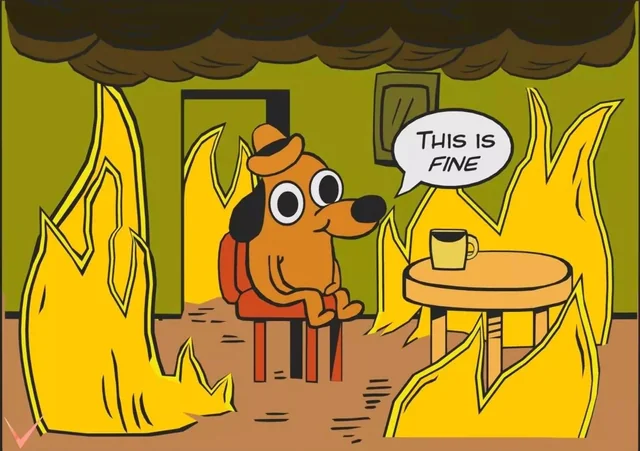
The Government has finally published a report it previously suppressed, calmly explaining that biodiversity loss and ecosystem collapse pose a direct threat to national security. Which is nice of them. Always good to know when the house is on fire, even if the alarm only goes off after the roof has already collapsed.
The report itself is actually quite readable. That’s part of what makes it so disturbing. It doesn’t scream. It doesn’t rant. It doesn’t glue itself to the road or throw soup at a painting. It just politely lays out, in civil-service prose, how the life-support systems of the planet are failing, and how that might be a bit of a problem for economies, borders, food supplies, public health, and, you know, civilisation.
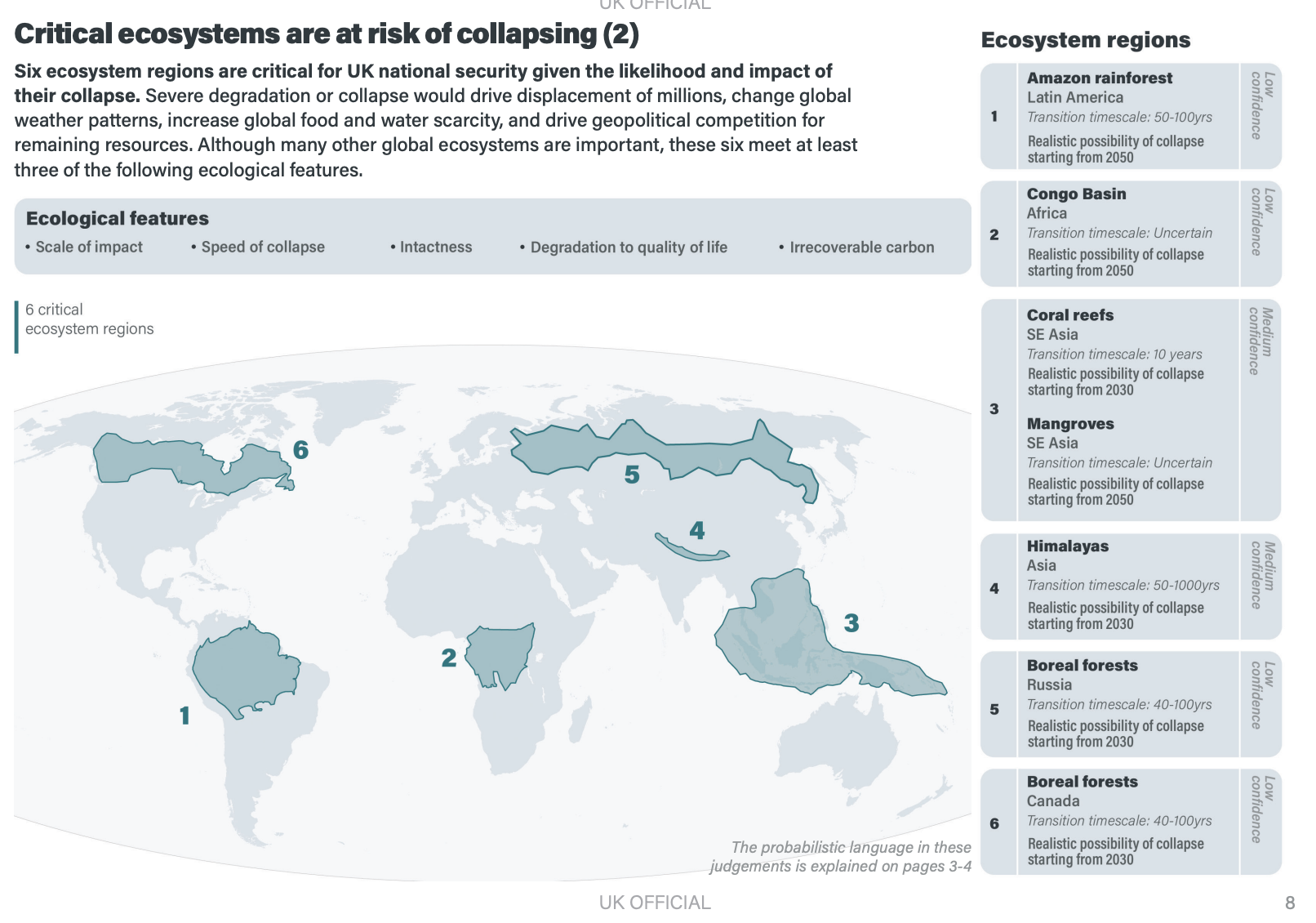
Critical ecosystems are at risk of collapsing
If anything, it feels conservative, which is fairly typical of government or scientific reports on the climate and nature crises. Multiple critical ecosystems – coral reefs, boreal forests, major mountain systems like the Himalayas – are expected to collapse soon. Not in 2100. Not for our grandchildren to worry about. Soon soon. Others, including the Amazon rainforest, the Congo Basin and mangrove systems, are likely to follow. Dominoes, but with forests and oceans instead of plastic rectangles.
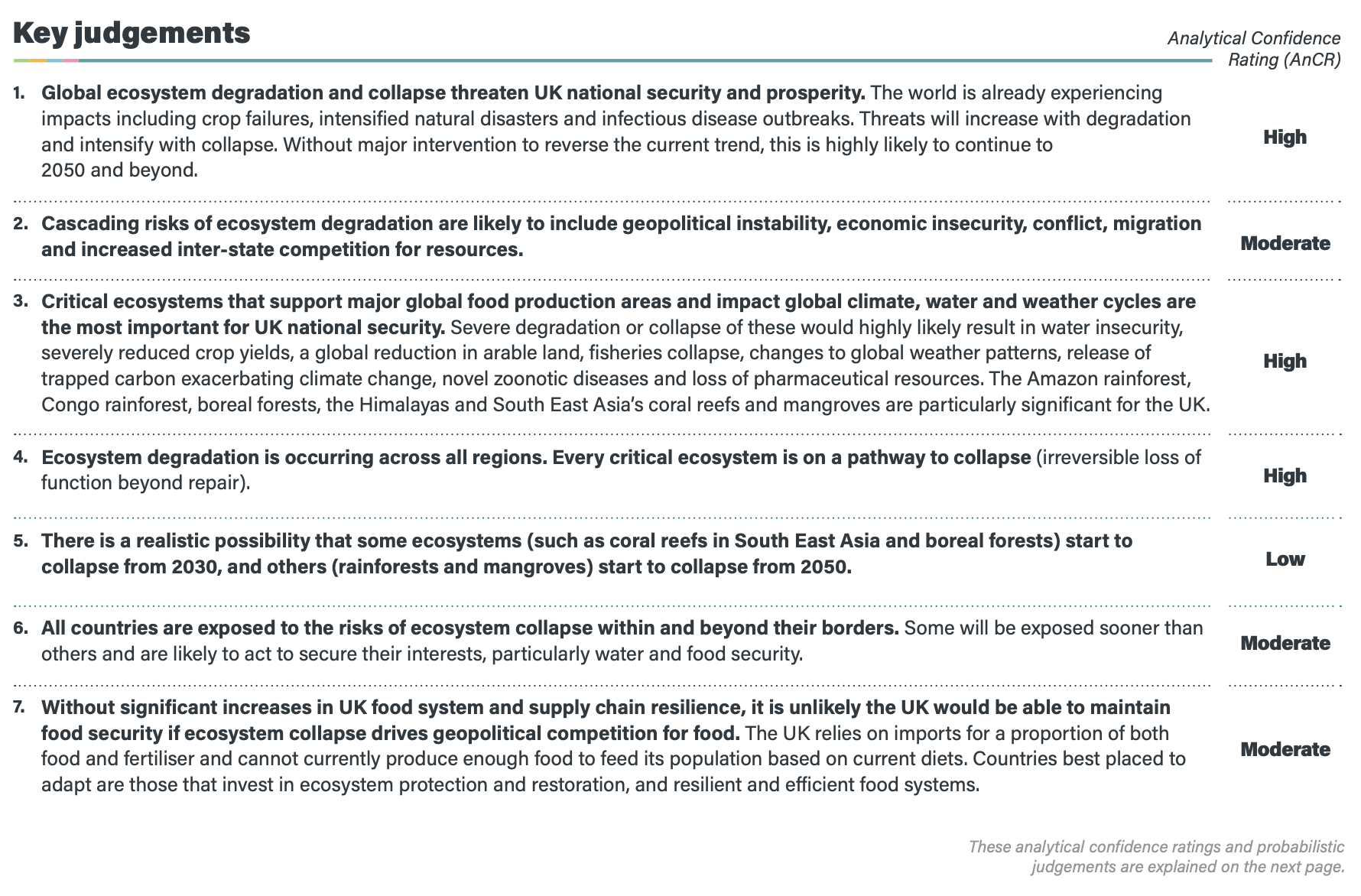
Key judgements
Meanwhile, atmospheric CO₂ has reached 428 parts per million, and the line on the graph is still curving upward. That single number underpins a whole cascade of consequences: climate breakdown, ecosystem collapse, floods, fires, crop failures, water stress, resource conflicts, mass migration, disease outbreaks, and increasing parts of the planet becoming uninhabitable. From there, social instability and collapse aren’t radical ideas — they’re logical outcomes.
Much of this is already happening, of course, especially in poorer countries that did the least to cause the problem and are least able to adapt. But don’t worry – I’m sure the market will fix it. Any day now.
What’s particularly maddening is that this isn’t some unsolvable mystery. There is no missing equation. No magical technology yet to be invented by a mega-corporation keen to make an even more obscene profit. We already know what to do.
We could fly less. Eat less meat. Scale up renewable energy at speed — the way China is doing while we argue about whether onshore wind or solar is “a bit unsightly”. We could rewild vast areas of land instead of treating nature like a decorative afterthought. We could protect rivers, lakes and oceans – which might help if water companies weren’t allowed to behave like extraction businesses with a sewage fetish. Public ownership, anyone?
We could grow more food locally. Insulate our homes properly. Use public transport that actually works. Stop pouring obscene amounts of energy into data centres and AI so that a chatbot can write slightly worse emails than a human already can. None of this is revolutionary. It’s just unfashionable — and it directly contradicts the Government’s growth mantra.
There will be no growth, of money or nature, on a planet stricken by floods, fires and water shortages, or on one with finite resources that will inevitably run out, despite billionaires’ protestations to the contrary. It’s all a bit King Cnut — in fact, with a little rearrangement, that surname could apply to many world leaders and tech bros.
History remembers King Cnut kindly; he was making a point — today’s leaders genuinely expect the tide to obey.
What really blocks progress isn’t technology — it’s power. Decisions about the future of the planet are still overwhelmingly made by a small group of ageing men, many of them white, some of them inexplicably orange, who will be comfortably dead before the worst consequences arrive. They continue to gamble everyone else’s future while telling us to be realistic. At times, I genuinely wonder whether Trump’s plan is simply to burn everything down, unable to tolerate the idea of a world continuing without him.
And here’s the thing: if we fail to act, the consequences won’t land on some distant, hypothetical generation. They’re already landing. They will fall hardest on our children – many of whom may never grow old enough to reach our age, let alone retire.
But don’t worry. The plan still seems to be: carry on, extract more, emit more, suppress awkward reports, and hope no one joins the dots.
Salt, Sea Devil ambassador: “These are the words of a politician, vetted and craven and hollow. You would answer.”
Barclay, Ambassador for human-kind: “Because we were stupid. That’s the truth of it. And the whole planet is going to hell right now because we didn’t understand the consequences.”
Salt, Sea Devil ambassador: “But now, you do?”
Barclay, Ambassador for human-kind: “Yeah, now we do. Still every day water companies are pumping poison and sewage into our rivers and oceans, all the while dishing out bonuses to their bosses. And the thing is, we are letting them get away with it! We’re just sat at home, flicking through our phones, making tea, thinking it’s someone else’s problem! But it’s not. This is my fault. We all played our part. Now we have to help fix it. And the thing is, our kids know this! Our kids. They’re way ahead of us! Why aren’t we listening? Well, today’s the day we start.”
Salt, Sea Devil ambassador: “I think you are my favourite human.”
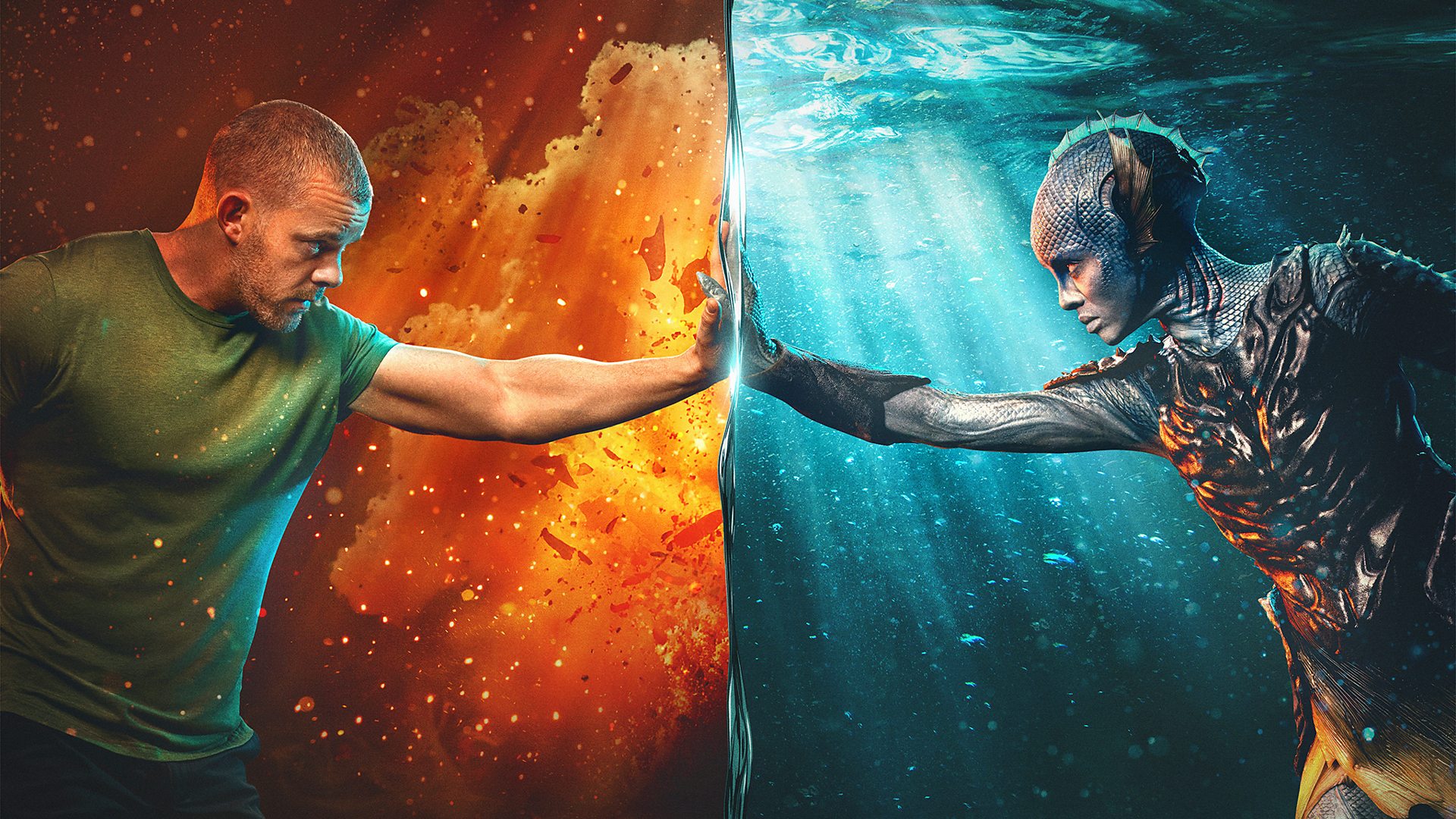
This exchange from the new BBC/Disney+ series The War Between the Land and the Sea stayed with me long after the episode finished. The sets, costumes and visuals are impressive — but it was Barclay, the unlikely ambassador thrust into responsibility, who delivers the most piercing truth:
“And the thing is, we are letting them get away with it!”
“Why aren’t we listening?”
Two lines that feel painfully relevant.
Water companies, oil and gas giants, the media, the banks, and the politicians who prop them up have been getting away with it for decades — and we’ve let them.
Where am I going with this?
This post is about why we must accelerate the transition to renewable energy, whilst also bringing essential services like water back into public ownership. For decades, executives have prioritised profit, bonuses and shareholders over public good. Since privatisation in 1989, it’s been yet another “victory” for neoliberal capitalism — one that has spectacularly screwed us over.
We’ve Been Betrayed
The science on greenhouse gases has been clear for almost two centuries.
In 1824, Joseph Fourier described the greenhouse effect.
In 1861, John Tyndall identified the gases responsible. The Tyndall Centre for Climate Change Research — named after Tyndall — is just down the road from me in Norwich.
In 1900, Knut Angstrom, discovers CO2 strongly absorbs parts of the infrared spectrum.
In 1938, Guy Callendar showed that temperatures rose over the previous century. He demonstrated that CO2 concentrations had increased over the same period, and suggested this caused the warming. His claims were dismissed.
In 1968, US President’s Advisory Committee panel warned that the greenhouse effect is a matter of “real concern”.
In 1975, scientist Wallace Broecker put the term “global warming” into the public domain.
The above has been followed by countless IPCC (Intergovernmental Panel on Climate Change) assessments, and COPs (Conference of the Parties) to try to solve the challenge of climate breakdown. Some progress has been made, but not nearly enough.
We’ve known the facts. We’ve proven them. And yet oil and gas companies hid their own research, just as tobacco companies once hid the link between smoking and cancer. Billionaire-owned media outlets are defending them. Politicians were and are being lobbied into paralysis – just look at COP30. And so we are being lied to, misdirected and exploited whilst the planet is burning.
We have been failed time and time again by successive Governments who have put the interests of mega-corporations, profit and power, ahead of ordinary people. They have betrayed us to the altar of profit, lied, misdirected, and in some cases filled their pockets with blood money.
We didn’t “fail to understand” — we are being denied the truth.
We’re Not Stupid
Barclay says, “Because we were stupid.”
But we weren’t. We were and are being deliberately misled.
Instead of honesty, we got greenwashing, smokescreens, and faux responsibility — like BP inventing the personal carbon footprint calculator to shift the blame from corporations onto individuals.
Imagine if the public could be given the same clarity scientists shared recently at the National Emergency Briefing. The shift in understanding — and action — might come rapidly and radically.
You can find recordings of the various segments of the National Emergency Briefing on YouTube.
How Fast Can We Decarbonise?
In the UK, we’ve reduced emissions — but we still emit far more per person than many countries with less wealth and fewer resources. And we should have made the major cuts twenty years ago. We’re now out of time for a gentle transition. We must act rapidly, even if it’s uncomfortable.
This will upset people, especially in a country used to convenience and abundance. But climate physics does not negotiate. Deaths, harm, migration, are all being caused right now by our carbon emissions.
Our Obligations
We are privileged — often without realising it. Given our historic emissions, the UK has a moral obligation to move first and fast.
The alternative? Pull up the drawbridge, protect ourselves for a few extra years, and ignore suffering elsewhere. But our food imports, supply chains and future mass migration make that fantasy laughable.
Billions will be on the move. The question is whether we meet that future prepared — or panicked.
Tell the Truth
People are not being told the truth by politicians or the media. If they were, they’d understand what we are facing:
As laid out at the National Emergency Briefing, the collapse of AMOC (the Atlantic Meridional Overturning Circulation – a crucial system of Atlantic Ocean currents acting as a giant conveyor belt) could mean:
–30°C winters
extreme summer heat
chronic water shortages
the UK unable to grow food
the British becoming climate refugees
The irony isn’t lost on me; one wonders whether we’ll have enough small boats.
Extinction Rebellion warned we needed major emissions cuts in 2018. Oil and gas companies and wealthy governments around the world denied it, buried it, or have since waved around Carbon Capture and Storage — a technology unproven at meaningful scale, and one that conveniently ignores the huge emissions from extraction and transport of natural gas in the first place. Profit over life, again.
So, What Can We Do?
We need rapid, large-scale deployment of renewables:
Wind
Solar
Tidal
Geothermal – there’s some exciting stuff going on with old coal mines
Fusion power would be ideal, but remains underfunded and decades away. We also need to upgrade the grid and to build massive battery storage facilities. This is all doable and exciting, and will create huge potential in terms of sustainable economic growth, jobs and wellbeing, we just need the politicians in power to stop dragging their heels.
But there are obstacles. Solar is a prime example.
Solar Energy: What’s The Problem? Rooftop solar is brilliant — low impact, popular, and efficient. But we no longer have the luxury of time. Large solar farms are faster to deliver and much cheaper per megawatt.
Using ChatGPT for initial comparisons (yes, with a pinch of salt but it saves me hours of trawling through websites and research papers), I asked, when looking at the electricity 4,000 acres solar panels could generate, what is cheaper and quicker to build – a large solar farm or rooftop mounted solar:
Large Solar Farms
400MW: ~£400–600m plus land/grid costs
800MW: ~£800m–1.2bn
Build time: 12–24 months after permitting
Distributed Rooftop Solar
400MW: ~£600–800m (likely more)
800MW: ~£1.2bn–1.6bn+
Rollout time: 5–10+ years
Planning times for solar farms could be slashed if government finally treated the climate emergency like an emergency.
And then there’s capitalism: energy companies don’t want millions of small producers cutting into profits. Legislation could fix this — but it requires political will. We already know neoliberal capitalism needs serious reform.
As for the criticism that solar farms use agricultural land:
They would occupy only 0.45%–0.82% of agricultural land, some of which is fallow at the moment anyway.
We already face food insecurity. Solar barely dents agriculture.
Meanwhile, golf courses consume five times more land than solar would — and I know which I’d rather repurpose.
You can’t tee off on a golf course that’s underwater.
Unfortunately, there is significant opposition to solar farms, largely from people living near proposed sites — which is understandable
Grid Upgrades: The Unavoidable Backbone
We need new pylons, underground cables, or subsea routes — plus battery storage. None of this is optional, and the arguments are similar to the above. All options have ecological impacts, but we’re out of time for perfect solutions.
Pylons may be ugly, but they’re cheaper, faster, and even capable of creating wildlife corridors. France has even turned some into public art. If only imagination were a UK policy priority.
Large Scale Renewables Are the Clear Winner
Solar farms and other renewable energy sources are the clear winner if our priority is rapid decarbonisation. They are cheaper, quicker to build, will create new jobs and provide clean energy. They are our future proofing.
We face a choice: continue failing, continue betraying younger generations, retreat into selfishness and isolation—or respond to the climate and ecological emergencies with the urgency they demand, adopting something akin to a wartime mobilisation.
It may already be too late to avoid severe impacts. But every fraction of a degree of avoided warming saves lives, ecosystems and stability.
CO₂ rises → temperature rises → runaway climate impacts:
floods, fires, drought, famine, harvest failure, extreme weather, mass migration, ocean collapse, extinction events… and then societal collapse.
The stakes could not be higher.
The Path Ahead
We change — or we face the consequences.
The graph below shows how CO2 concentrations in the atmosphere have changed over the millennia, using data from ice core samples.
Renewables give us a fighting chance of reducing emissions and avoiding societal collapse. Oil, gas and nuclear leave only waste and devastation. Renewables can coexist with nature and even help restore it when designed well.
It comes down to communicating honestly, successive governments, oil and gas companies, supported and controlled by billionaire media magnates, have denied people that honesty: change now, or our children will not live to the same age we do.
We don’t have to let them make us stupid, but they won’t change on their own. We have to force it.
From billionaires. From fossil fuel companies. From media moguls. From corrupted politicians who may not even realise how compromised they are. Let’s stop them getting away with it.
They’ve been getting away with it for decades. They are “craven and hollow.” We can stop them.
And yes — I’m going to say it:
Vote Green. Let’s make hope normal again
Promoted by James Harvey on behalf of Broadland Green Party, a constituent party of the Green Party of England & Wales PO Box 78066, London, SE16 9GQ
I recently wrote to the BBC to complain about their coverage of the climate crisis, which I, and many others, believe remains woefully inadequate given the existential threats it poses. Below is the complaint I submitted.
Coverage of climate change
I’m writing to complain about the BBC’s inadequate coverage of today’s letter from the Climate Change Committee to Government on the UK’s preparedness for at least 2°C of global warming by 2050.
This is a matter of profound national importance, yet your main news programmes gave it little to no prominence. Such omission feels negligent at best, and at worst suggests a deliberate downplaying of vital information, whether due to editorial decisions, management influence, or political pressure. The public deserves transparency on issues that will shape our collective future. It is already known that Downing Street blocked a government report warning that the collapse of rainforests, reefs, and mangroves could raise food prices in UK supermarkets.
Earlier this year, the Institute and Faculty of Actuaries (IFoA) warned of escalating climate risks -more floods, fires, droughts, and ecosystem collapse. Their analysis projected GDP losses of up to 50% between 2070 and 2090, and warned that global heating of +3°C, possible as early as 2050, could cause over 4 billion deaths, societal collapse, and extinction events.
Despite the gravity of these findings, BBC reporting on the climate and nature crises remains inconsistent and insufficient. This undermines your stated purpose “to provide impartial news and information to help people understand and engage with the world around them.”
While I appreciate an article appeared on your website, this story should have led your main news bulletins, with clear context on what climate breakdown, mitigation, and adaptation mean for ordinary people. It would not have been difficult to feature credible climate scientists or policy experts.
I urge the BBC to give greater priority to the climate and nature crises, ensuring the public are properly informed and able to make meaningful democratic choices, particularly about which leaders and policies will act to safeguard our future and that of coming generations.
The CCC warns that the UK must urgently strengthen its adaptation objectives to protect food security, infrastructure, public services, the economy, and access to financial services such as insurance. Many properties are already becoming uninsurable due to flood risk.
We are beyond the stage where it’s possible to mitigate all catastrophic climate impacts. Yet the current levels of adaptation -and even the plans for adaptation – remain unambitious and wholly inadequate. Inadequate seems to be the word of the day when it comes to both government and media responses to the climate and nature crises.
This is the response from the BBC I received last night:
Dear Mr Harvey,
Thank you for getting in touch about BBC News at Ten on 15 October.
We’re sorry you feel insufficient coverage was given to the letter addressed to the government from the Climate Change Committee (CCC), warning that the UK should be prepared to cope with weather extremes as a result of at least 2C of global warming by 2050.
We know that not everyone will agree with our choices on which stories to cover, or the order in which they appear. Our news editors make these complex decisions, based on the editorial merit of all the stories at hand. We accept that not everyone will agree with each decision – various factors are at play and there’s often debate in the newsroom too.
BBC News did cover this across our news outlets however and you can read the online report here:
The BBC has been reporting on both the effects of climate change and the changes that individuals and governments can make in order to reduce carbon emissions for many years. In recent years these reports have had increased prominence as the evidence grows about the speed and impact of climate change.
To read our latest News on the issue of climate change, you may be interested in the following link:
We can assure you that the BBC is committed to providing fair and impartial coverage of the latest News stories to our audience, and climate change is an issue that the BBC takes very seriously.
We very much value your feedback. Complaints are sent to senior management and we’ve included your points in our overnight reports. These reports are among the most widely read sources of feedback in the BBC. This ensures that your concerns have been seen by the right people quickly, and helps to inform decisions about current and future content.
I appreciate that the complaints team forwards feedback to senior management, and I can only hope that the BBC – and the wider media – will soon recognise the urgency of reporting on the existential crisis that is climate breakdown.
This crisis threatens the lives and livelihoods of billions over the next 25 to 50 years — and millions are already being affected, displaced, and killed by its impacts. It demands coverage that reflects its true urgency, accuracy, and frequency.
I’d be very interested to hear what others think — please feel free to leave a comment or share your perspective below.
I find it increasingly strange, and frankly disturbing, how we’re being conned by politicians, much of the media, and mega-corporations. From birth, we’re bombarded by advertising designed to shape our thinking; by MPs who chase votes with half-truths, misdirection, or outright lies; and now by social media echo chambers that trap us in a cycle of misinformation.
As a Green Party member, I find it refreshing to have leadership that isn’t afraid to tell the truth. As a district councillor, I can vote in the best interests of my constituents – and with my conscience – rather than following the orders of a party whip. Zack Polanski’s election as Green Party leader, by a huge majority, has brought articulate and intelligent debate to the forefront again – on immigration, the climate crisis, renewable energy, and human rights. His policies on taxing the super-rich (the top 1%), reforming the private rental sector, renationalising water companies, and providing universal free childcare are resonating deeply with people across the country.
Green Party membership is now over 140,000, making us the UK’s third-largest political party. Polls put us around 15% of the vote, level with the Lib Dems and closing in on Labour and the Conservatives. Reform UK may be polling slightly higher, but perhaps that’s unsurprising when they’re not bound by things like telling the truth, or avoiding donations from dubious sources. People are joining the Greens in their thousands because we’re the only party that speaks plainly, answers questions directly, and puts people before profit.
Why don’t other political parties do the same? Surely an MP’s job is to represent their constituents – and by acting in their best interests, you’d think re-election would follow naturally. But that’s not how it works. Other parties are deeply influenced by corporate lobbying. Labour, for instance, met oil and gas company representatives over 500 times in their first year of power – that’s an average of two meetings every working day between ministers and fossil fuel lobbyists. Meanwhile, the Conservatives, Labour, and Reform continue to accept large donations from oil and gas interests, climate denial think tanks, and polluting industries. Is it any wonder, then, that their policies serve those industries – while the public is distracted with talk of immigration and welfare spending?
There’s a growing frustration with politicians who dodge questions or distort the truth. Brexit was, in part, a reaction to this. Westminster has become synonymous with elitism, corruption, and detachment from reality. It’s not even a criminal offence to lie in the House of Commons. Again and again, politicians mislead the public with impunity, aided by a media that too often fails to hold them accountable—especially those on the right.
Why isn’t Nigel Farage grilled about the £350 million-a-week NHS pledge that vanished after Brexit? Or challenged on the fact that immigration is essential to sustain our NHS, care sector, farms, and schools, as well as to support an ageing population and pensions system? Why aren’t we hearing that renewable energy is cheaper, faster to build, and infinitely safer than oil and gas?
In 2008, I was fortunate enough to visit the Great Barrier Reef on my honeymoon and swam among the coral and turtles – a breathtaking experience. Last week, I read that we’ve passed the planet’s first major climate tipping point: warm-water coral reefs are dying and will soon disappear. Hundreds of millions of people depend on them for food and livelihoods. Other tipping points – Amazon rainforest dieback, ocean current collapse, permafrost melt, and ice sheet loss – are not far behind. Each accelerates the next, creating feedback loops that speed up climate breakdown.
Then, this morning, I received an email from the Government responding to a petition to halt airport expansion. Part of it read:
“The Government therefore supports airport expansion where proposals contribute to economic growth, can be delivered in line with the UK’s legally binding climate change commitments, and meet strict environmental requirements on air quality and noise pollution.”
The list of planned expansions – Gatwick, Luton, Stansted, and beyond – was all about “economic growth” and maintaining the status quo. But if we don’t act decisively to cut emissions, climate breakdown will destroy any chance of growth – and in some regions, any chance of survival.
Carbon dioxide levels are still rising. Meanwhile, the fossil fuel industry funds anti–net zero campaigns and uses politicians as mouthpieces to protect their profits. Green energy offers a massive opportunity: it can create jobs, cut bills, and reduce emissions. We could lower bills immediately by cutting the link between electricity and gas prices, but that would hurt oil and gas profits, so it doesn’t happen. These same companies continue to receive huge public subsidies that dwarf support for renewables.
Airport expansion is simply incompatible with our climate goals. No amount of greenwashing through “sustainable aviation fuel” or dodgy carbon offsetting schemes will change that.
If we’re serious about telling the truth, we need to be honest about green energy too: why we need to decarbonise, why solar panels (covering just 0.7% of UK land – less than golf courses) can help power our future, and why upgrading the grid and installing battery storage is essential – even if that sometimes means projects are built near where we live. Time and money are tight, and we don’t have time to always wait for the perfect solution.
The clock is ticking. Hundreds of millions in the Global South are already dying from floods, fires, famine, and disease linked to climate breakdown. We’re not immune here either: UK farmers face failing harvests, rising food prices, and more frequent flooding. Some truths will be uncomfortable and require lifestyle changes – but that’s a small price to pay compared with a world of famine, fire, and forced migration.
Scientists and even insurance companies are warning us. The Institute and Faculty of Actuaries (IFoA) recently projected global GDP losses of up to 50% between 2070 and 2090 and warned that a +3°C world – possible as soon as 2050 – could cause over four billion deaths, social collapse, and mass extinction events. GDP loss seems almost trivial in comparison.
The Green Party tells it like it is – guided by science, compassion, and a commitment to act in the best interests of the majority, not a privileged few. Our membership continues to grow rapidly. We’re out on the streets, talking to people, telling the truth, and offering real solutions not tainted by corruption or corporate influence.
The good news? If we act now, we can still build a fairer, healthier, and more hopeful future – for ourselves, our children, and the countless other species we share this planet with.
Come join us – and let’s make hope normal again.
Promoted by James Harvey on behalf of Broadland Green Party, a constituent party of the Green Party of England & Wales PO Box 78066, London, SE16 9GQ
I love it when it snows, and after several years of nothing significant the ‘Beast from the East’ brought buckets of the stuff over the past week. The only draw-back, from my point of view anyway, is that it makes cycling a little tricky; I don’t have any studded tyres.
More snow than Norfolk’s had in years
A winter wonderland
Salhouse Broad froze; although melting by the time I got this photo
Imagine if we could control the weather; but would that really be a good thing? The potential benefits around, for example, a predictable climate for agriculture, sunshine for the tourist industry, or rain for drought hit areas all sound good. But what about the impacts we couldn’t foresee or chose to ignore?
Controlling the weather in one region could adversely impact another geographical area, where perhaps they didn’t have as much money or influence. This downstream area could get hit by extreme weather, or mass species die-off events could become more common-place, such as the Saiga antelope catastrophe in Kazakhstan. In excess of 200,000 of this endangered species died in 2015, when human-caused climate change increased temperatures to such an extent it’s thought they triggered a bacteria present benignly in the antelopes at lower temperatures to cause hemorrhagic septicemia (blood poisoning and internal bleeding), with thousands dying within a few days of each other.
An increase in life-threatening diseases due to climate change could happen to human population centres, and some would argue it already is. For example Nigeria is currently experiencing an outbreak of Lassa fever, which in extreme cases has symptoms similar to Ebola, and has no vaccine. There are some theories that the increased frequency of this disease could be down to changing weather patterns.
So no, I don’t think we can be trusted to control the weather responsibly. We’re already doing it indirectly via human-caused climate change due to fossil fuel burning. The recent snowy weather resulted from unseasonably warm air being drawn up to the arctic, the Jet Stream slowing down and disrupting the polar vortex, which forced cold air and blizzards down to the UK. Whilst we experienced temperatures well below freezing in Norfolk, it was above freezing in parts of the Arctic, melting yet more of the already at record lows sea ice. This is explained much more eloquently and in far more detail on this website – well written and easy to understand; definitely worth a read.
Where am I going with this? I’m pointing out we often don’t really understand, or are unable to predict, the consequences of our actions on the planet.
As I mentioned in a previous recent blog post I’ve been pondering where we’re going as a species, and why we keep pursuing unsustainable growth and consumption, whilst the world literally collapses around us. Climate change is becoming a very tangible symptom of our labours. Surely we should be petrified for the future of our children and grandchildren, if not the other species we share the world with. Yes, the planet will survive us, however will anything else on the Earth be left by the time we check out?
There are lots of examples of as yet un-checked unsustainable activity in the present day, which we seem to be in denial about. All these have either obvious, as well as I suspect as yet unpredicted consequences. Here are a few examples.
Human population growth. The world’s population is growing at around 83 million or 1.1% a year, although this rate has slowed down since peaking in the 1960’s at about 2.1%, and is predicted to fall further to around 0.1% by 2100. The graph below shows how dramatic this growth has been in the last 200 years. The impact this puts on the environment, especially as more of the population start to live ‘western’ lifestyles, is unsustainable.
Agricultural land use. Asthis article in the New Scientist from 10 years ago says; humans are living completely beyond their ecological means. We knew this a long time ago but still pump fields full of fertilisers and pesticides, which in the long-term degrades the land and makes it less productive, as well as poisons the underlying substrates and surrounding countryside, reducing biodiversity. That coupled with soil erosion means scientists are predicting we only have a limited number of harvests left, maybe 100, due to our unsustainable farming practices. The good news is this should be reversible, given the right techniques and less reliance on chemical fertilisers. The big agrochemical companies, such as Monsanto, don’t really want you to know this for obvious reasons. Check out this video from Dr Elaine Ingham if you want to find out more, a real eye-opener.
Fishing. In many areas of the world we’re literally stripping the oceans bare of life to feed our appetite for seafood. Huge industrial trawlers and dredgers indiscriminately take everything, and even if by-catch is thrown back it’s probably not going to survive. Studies have shown that fish numbers have halved since the 70’s, with some species being hit particularly hard such as tuna and mackerel; a 75% decline in numbers. Continued unsustainable fishing practices driven by consumer demand, coupled with horrific plastic pollution and coral reef bleaching, paint a grim picture as far as recovery is concerned. If however large areas of our oceans are designated as marine conservation areas, such as the Arctic, perhaps they’ll stand a chance.
Meat eating. There are hundreds of articles out there, such as this one, describing the impacts of raising livestock on the environment. As demand grows due to an increasing population and new markets, the impacts will grow. These include a large contribution to the greenhouse gases causing climate change, increased pollution due to run off, increased water use, and more land being needed to for livestock resulting in deforestation. The amount of land needed to feed a human on meat is about 20 times more than needed for a vegetarian diet. This is clearly unsustainable. The answer seems obvious, eat less meat and dairy products, with the associated health benefits as side-effects.
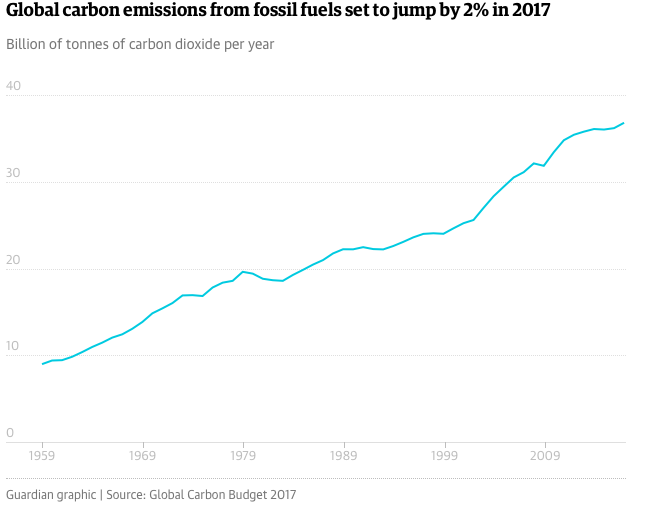
Fossil fuel use. We continue to burn vast amount of fossil fuels such as oil, coal and gas, in order to generate energy, heat our homes, or power transportation. The CO2 emissions from fossil fuel burning continue to increase, despite the Paris Climate Change agreement being signed in 2015. Burning fossil fuels is the primary cause of climate change. We have perhaps 100 years left of these primary fossil fuels, which means we’ll have used up what the world has to offer over the course of about 300 years, reserves that took millions of years to create. This has to be one of the best examples of unsustainable human-based activity, however with continued research and development hopefully alternatives such as electric cars (go Tesla!), renewables, or fusion energy will increase or come online soon.
CO2 emissions from fossil fuel burning
Those were a few examples of unsustainable activity, which seem to make less and less sense to a growing number of people, especially the younger generation who don’t understand how we could, as a race, have been so ignorant, and how we continue to pursue these activities. I think they’ll be an accounting at some point, and the history books won’t look back kindly on what will come to be regarded as criminal practices. It can be summarised quite simply…
Infinite economic, industrial and agricultural growth is unsustainable and therefore impossible when based on finite resources, coupled with environmental constraints
…not sure one can argue with that. A basic example of this can be found from studying the growth of a bacterial colony in a petri dish. The colony starts off slow, then grows exponentially using up the finite resources available, then dies off once the agar jelly runs out. A simple example but with obvious parallels to humans and the Earth.
There’s a lot of hope out there in terms of alternative more sustainable options, however these are reliant on:
Public take up of the alternatives, and a willingness on everyone to make sacrifices to ensure long-term sustainability
Funding for the research and development of these initiatives
The same initiatives not being blocked due to profit seeking by the incumbent industries, who wield so much power and influence
Politicians actually listening to their constituents and scientists
I’ve been reading recently about shifting baseline syndrome. Over time knowledge is lost concerning the state of the natural world, as people don’t perceive the changes taking place. Today’s younger generation won’t for example remember that gardens used to be full of butterflies, or that birdsong used to be so much louder, or that rhinos were once commonplace in Africa. It has to be a concern that the environment and biodiversity will continue to decline due to unsustainable activity, but people won’t realise the extent of the decline because they have no first hand experience of what things used to be like.
Over the last 25 – 30 years: (Source: WWF-UK Living Planet Report)
80% of freshwater species have declined
Over 50% of populations of land species have declined
40% of our forests have disappeared to agricultural land with 15 million trees lost each year just for soy production
1 in 6 of the planet’s species are at risk of extinction from climate change
I hope that education will fill this gap, and Deep Ecology will start to become part of the syllabus; humans are just one of many equal components that make up the global ecosystem. We’re not above or apart from it, we’re a part of it, and could not only survive but thrive if things are done the right way.
I don’t know how we change public opinion quickly enough to make the changes needed to ensure we can survive and thrive. Most governments don’t seem to give it a high priority, or are swayed by lobbyists driving their own commercial agendas, and whilst industry is changing it’s debatable whether it will happen quickly enough. It’s bizarre that we can continue so blithely down this path when you can for example see the ice melting, species dying, diseases increasing, the plastic in our oceans, antibiotic resistance rocketing, and extreme weather events due to climate change happening. I can only assume most people are in a massive state of denial, and refuse to wake-up, because to do so would cause a mental breakdown.
The underlying causes of all this have to be the drive to consume (we’re all indoctrinated to do so from an early age via marketing), what we are taught to regard as being successful in life, the pursuit of unreasonable profit and therefore money by a relatively small percentage of the population, and the often mistaken belief that more money will make you happy. After being on my bike for six months travelling round Europe, I realised you need very little in order to be happy. It looks increasingly like we need an alternative model from capitalism, which no doubt had its place in the past, in order to endure. That’s maybe a topic for another blog.
If you don’t already know about it Earth Hour takes place this weekend, where people are encouraged to turn their lights off from 20.30 in a show of solidarity for the planet. Here’s a link to the WWF website which has more detail on it – https://www.wwf.org.uk/earthhour
Well done and thank you if you made it to the end of that one. As usual my opinions are my own, however I hope that many of you will agree seeing as the evidence around all this is so easy to come by (see sources), and that you’ll conclude that we need to stop now and make some changes. I think everyone really can make a difference, because trends and movements spread and grow when they make sense. Let’s rectify this:
People and nature in Venn diagrams
As always, safe cycling, and please feel free to comment with any feedback, opinions or interesting links to further information.
It’s spring again, after yet another wet and windy winter. I’d better go out and feed the chickens, but can’t say I feel particularly motivated to do so, not with the rain lashing against the window, sending muddy streams of water running down the hill to the already swollen river.
At least we don’t live in the village, that’ll be flooded again. I’m surprised more people haven’t moved, but I guess folks are clinging on to what they can these days. Maybe I’ll trade the last orange with the kids, as payment for doing the morning chores; we don’t see much in the way of oranges, and haven’t done for several years now, not since the new laws came in around carbon footprints. As for bananas, the children have never had one, they got wiped out by some new fungus that couldn’t be eradicated in time to save the plantations, and they’d be too far away to transport now anyway.
Still, life is pretty good, all things considered and despite the lack of exotic foodstuffs. There’s definitely more of a community spirit, and healthier lifestyles going on, both mentally and physically. Sod it, I’ll save the orange for later.
I bang on the kid’s bedroom door to wake them from their respective slumbers, and put on my boots, heading out into the rain as the sun rises behind the clouds, and the neighbours ever hopefully cockerel welcomes in the new day. The constant whirring of the wind turbine supplying power to both our house, and those of several neighbours, reminds me that I should check the solar panels soon, now that we’ve more daylight they’ll need cleaning. There’s a lot more renewable energy now, with the ban on most fossil fuel burning in place. We’ve enough power for everything we need, unless it’s really cloudy and there’s no wind for an extended period. As long as the kids have an internet connection they’ll be happy, but I ration them to an hour online a day, aside from school, to make sure they have time for chores and learning skills that’ll be important should things deteriorate.
So much has changed in the last 30 years, and so quickly, faster than any of the scientists were predicting, or willing to predict anyway. The CO2 levels in the atmosphere rocketed, due to warming oceans soaking it up less and less, more being released from vast areas no longer locking greenhouse gases away under a permafrost layer, and humankind’s continued thirst for cheap and dirty energy. A few big and unexpected volcanic eruptions didn’t help either, although they did remind people we can’t control everything. We reached a tipping point where global temperature rises were locked in, and are still locked in despite a massive reduction in carbon emissions. In the space of about 20 years the big glaciers in the Arctic Circle had all but melted, causing sea levels to rise dramatically, and huge areas to be flooded; the Norfolk coastline certainly changed, however at least we’re still above water, unlike swathes of Bangladesh and India, the Maldives, and countless other areas around the world.
I let the chickens out, make sure they’ve got enough grain, then do the rounds to check everything is in order, the pigs are happy, and nothing’s been stolen overnight. We don’t have much trouble nowadays, compared with 10 years ago, but there’s still the odd band of desperate people about, those without a home or means to contribute enough in return for food. All’s well and I head back inside hoping Danny and Jess have got breakfast ready.
The altered climate brought with a whole host of challenges. Some areas had too much water, whilst other suffered from extended drought, causing huge population migrations. War had been the motivating factor before, however now climate change took over. Then things got really bad, with economic meltdowns in China and the US sending everyone else down the tube. This led to more unrest, with richer countries no longer able to help out those most in need, or unwilling to do so with so many issues on the home front. Borders started closing, but this didn’t stop huge numbers of people streaming into Europe from the Middle East and Africa. The dystopian future people had feared would happen started to become a reality, with fascism on the rise in many countries, and vicious crackdowns on anyone threatening to further destabilise already precarious governments. The UK, by virtue of the English Channel, was spared a lot of the problems that hit France, Germany and Scandinavia, especially after some radicals blew up the Channel Tunnel; no mean feat considering it was meant to be relatively bomb proof.
Danny and Jess are up and already half way through their breakfasts by the time I’ve shaken the water off my coat and sat down at the table. We chat about who’s doing what today as we munch our way through eggs and bacon, with a few rounds of toast for good measure. I’ll need to go and restock on butter from the farm down the road again soon, and we’re nearly out of jam, with a few months until we can make any more. My wife Cassy used to make the best jam, but she passed away a few years ago, one of the last to die of the Snow virus before a vaccine was made widely available. Danny and Jess will work on their schooling this morning, before helping out in the workshop this afternoon. I leave them to clear up breakfast and head there myself, keen to finish fixing up a couple of biofuel generators that have been on my to do list for the last month, and which the mayor chased me up on yesterday.
I think about Cassy, as I often do, as I get to work cleaning the generator alternators. I miss her so much, but life goes on and I still have Danny and Jess; I’m fortunate compared to so many others. Rising global temperatures and melting ice didn’t just cause sea level rises and intense storms, we got hit by diseases no one was expecting. It started with the Zika virus spreading like wildfire, and then a whole load of other outbreaks as vector numbers and their viable habitats increased. We saw more Ebola due to a deterioration in sanitation in parts of Africa, but the Snow virus was the worst. Scientists reckon it was something locked away in the ice that thawed and went airborne, infecting masses before a vaccine could be created. Survival rates were low, and death not pretty, with funeral pyres lighting up the countryside for miles. The latest stats estimate over 70% of the world population perished due to Snow, with outbreaks still happening in some remote areas; I guess that’s solved the overpopulation crisis. Weirdly Russia seems to have done a lot better than other countries, and there are more than a few conspiracy theories suggesting why that might be, however it might just be that they were more prepared to take drastic measures to look after their own.
I finish the generators, grab lunch with Danny and Jess who as usual seem determined to explain why learning algebra isn’t going to help with anything, then we all head back to the workshop to continue working on the tram components needed for the new network in Norwich; self-drive systems I have the knowhow to build, and which Danny and Jess can help with, sort of, they’re learning anyway, and I’ll get them working in the vegetable patch if they get bored.
It’s great we have power to run things like trams, and electric vehicles, as well as our homes. We didn’t a few years ago when huge storms wiped out a lot of the off-shore turbines; higher sea levels, and massive storm driven waves aren’t kind to turbine blades. Some places started to use old petrol and diesel generators again, but that didn’t last long, with a violent backlash from many who saw such things as the cause of all our problems, and rightly so might I add (just in case the Environment Ministry is reading this). How could the human race continue using resources that are essentially dooming us, for so long, ever since the industrial revolution…bastards…why didn’t they just think a bit more about the future and their children, instead of being so unwilling to make even the slightest change to their excessive lifestyles. We’ve got fusion coming online now, finally. We should no doubt have put more effort into developing it sooner, but hindsight is a wonderful thing. Fusion is going to take a few more years to roll it out across the country, however once it’s in place we’re sorted energy wise, and the last of the nuclear plants can finally be shut down for good, getting rid of another threat to the world’s future.
We knock off an hour before dusk, after a productive day on all counts, even if Danny did fall out of an apple tree trying to retrieve the drone he’d accidentally flown into its branches. They shouldn’t have been playing with it anyway, but I let that pass; they’re good kids for the most part, and I’m conscious they don’t get as much time to just be kids as they should. Over supper we watch the latest news reports, which aren’t all doom and gloom, despite more severe weather warnings as the persisting El Nino effect and disrupted Jet Stream send more storm fronts our way; nothing new there. There’s a great documentary on how marine life has recovered in the last 15 years, since the genocidal fishing fleets were put out of action, and demand fell due to a reduced population. It reminds me we should head up to the coast, not as far away as it used to be, to enjoy some fresh crab and restock on smoked fish. Although we don’t have all the food luxuries that were ever-present 30 years ago, we’re pretty well off now, and even have an abundance of some things, such as vegetables and meat, although we try not to eat too much of the latter. It was bad for a while, with anarchy reigning when food shortages hit and things collapsed, but we got there in the end.
We wash up and ensure any waste is assigned to the relevant pod for recycling, not that there’s much waste these days with packaging made illegal, and people taking their own containers and bags to pick up food or goods from merchants or the government-run outlets. That’s another thing that’s hard to believe nowadays; how could people in the 20th and early 21st century be so wasteful? We’ll be living with a legacy of plastic bottles for millennia to come, but at least we can reuse them for various things, and very few are produced new now due to the restrictions.
After dinner, and for a bit of fun, we take the electric motorbikes out for a scramble around the nearby forest track, wearing our light enhancing goggles to avoid crashing on the way there. We enjoy seeing who can perform the most outrageous stunts around the solar storage lighted track, and as usual Jess wins; she’s no fear that girl. After a chat with the neighbours on the way back, who are out for a horse ride and like us enjoying a break in the rain, we all plug-in to the Net for an hour before bed, surfing our way through games, adventures, social media or news, whatever takes our fancy, and occasionally interacting with each other, far away friends or relatives as we float disembodied in the ether; I can see why some people were tempted to go fully virtual.
Then some alone time. Jess and Danny are in bed. I sit by the wood burning stove which I’ve lit as a luxury, burning a few kilograms of our wood allowance, and reflect. We’ve made it, things are looking up for the human race now, as long as we remember lessons learned. A tear tracks down my face as my thoughts turn to Cassy, and all the others we’ve lost, including my parents, early victims of the Climate Riots. Yes, we’ve made it, Danny and Jess have a future, and as long as we continue to strive to live in harmony with Earth, rather than exploiting and abusing it and each other, we stand a good chance. There’s still the threat that the climate changes we’ve locked in will throw us some curve-balls, or the odd country might go rogue and contravene the Earth agreement; Russia still worries a lot of us, but we’re getting there. I wonder what our parents, grandparents, great grandparents would have changed if they could have only seen us now.
Interesting to write, and think about what life could really be like in the not to distant future. If not by 2050, then within the next few hundred years. It’s fascinating to think about how things could change, quite quickly, for the worse in the short-term, but better in the longer term, with sustainable policies coming into effect, and the human race living in parallel rather than perpendicularly to the rest of the planet, and technological advances still benefiting us. Of course I haven’t mentioned a zombie apocalypse, but I’ll save that blog post for another day.
Now if only everyone would really think about this, and the challenges ahead, and make changes before we’re forced to by circumstance.







 Self Propelled